 +971 58 515 9269

Certified vs Non-Certified Pre-Owned Luxury Watches in Dubai (What Truly Matters in 2026)

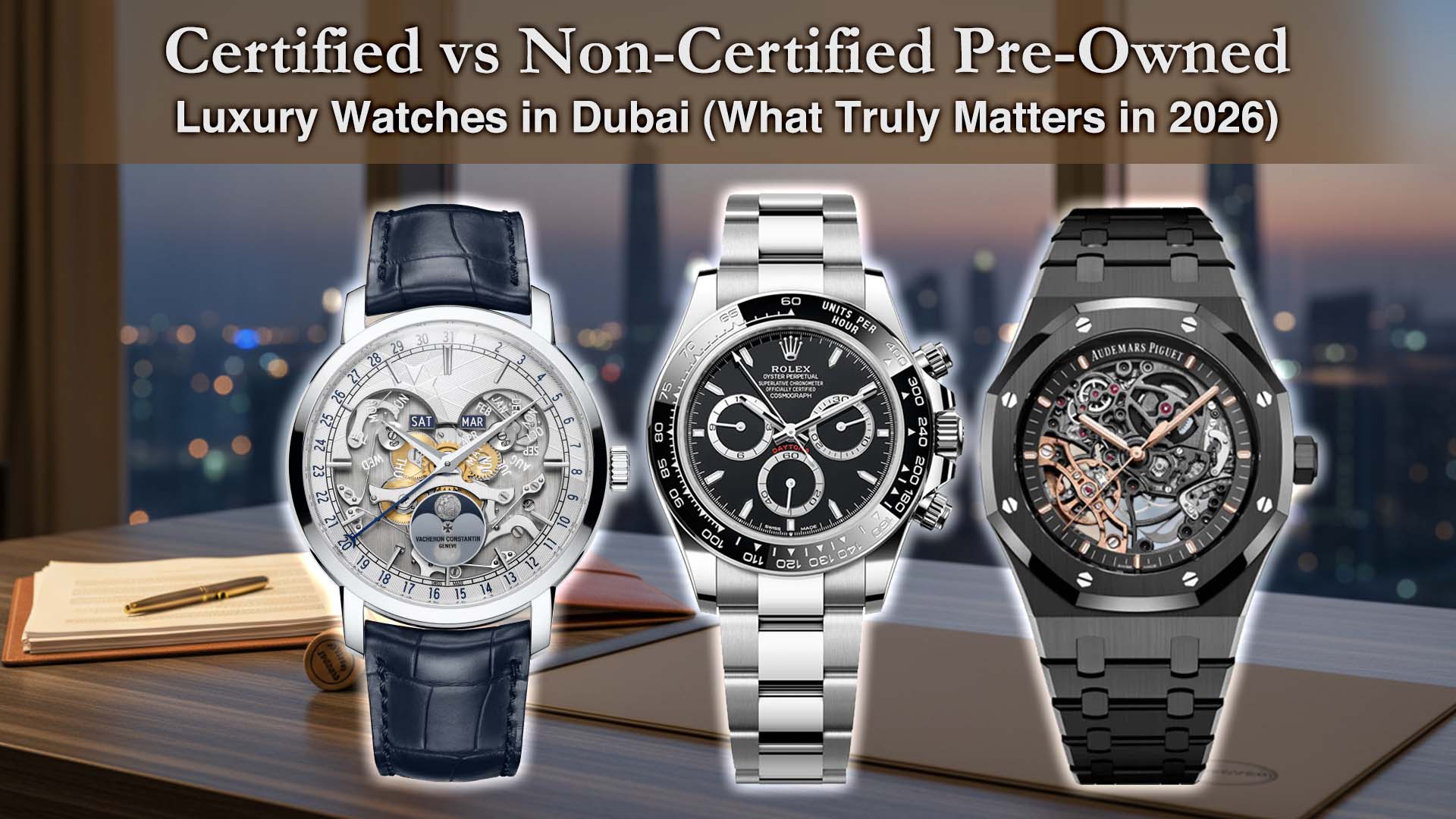
Understanding the Real Difference Between Confidence, Risk & Long-Term Value ⌚✔️
In Dubai’s luxury watch market, few topics generate more confusion than certified vs non-certified pre-owned watches. Many buyers assume certification automatically means “better,” while others dismiss it as unnecessary. The truth, as always in Dubai’s mature secondary market, sits somewhere in between.
In 2026, certification is not about labels or marketing language. It is about risk management, resale confidence, and buyer psychology. Understanding what certification actually represents—and when it genuinely matters—can save buyers from overpaying and help sellers position their watches more effectively.
This guide breaks down certification in practical terms, using Dubai’s real market behaviour rather than theory.
What “Certified” Really Means in Dubai’s Watch Market
In Dubai, a certified pre-owned luxury watch is not defined by a single authority. Certification typically refers to a structured process that confirms:
- Authenticity of the watch
- Matching serial numbers and components
- Mechanical functionality
- Accurate condition assessment
Certification may be issued by a brand, an authorised service centre, or a specialised luxury watch dealer with in-house expertise. What matters is not the word “certified,” but who stands behind it and how the verification was performed.
Dubai buyers tend to trust certification that is transparent and traceable—especially when it comes from platforms focused exclusively on high-end watches rather than general resale.
What Non-Certified Watches Represent (And What They Don’t)
A non-certified watch is not automatically a problem. In fact, many exceptional watches in Dubai circulate without formal certification—particularly older pieces, rare references, or watches sold between experienced collectors.
However, non-certified watches require:
- Stronger buyer knowledge
- Independent verification
- More cautious pricing expectations
In Dubai’s market, non-certified watches often trade at more competitive prices to offset the additional due diligence required. For informed buyers, this can present an opportunity. For inexperienced buyers, it introduces risk.
Why Certification Carries More Weight in Dubai Than Many Markets
Dubai attracts a global buyer base. Many buyers are not physically present, and many transactions involve international movement. In this context, certification acts as a confidence bridge.
Certified watches in Dubai benefit from:
- Faster buyer decision-making
- Stronger resale appeal
- Smoother cross-border transactions
This is particularly important for high-value pieces from brands such as Rolex, Patek Philippe, and Audemars Piguet, where buyer expectations are extremely high and documentation directly affects liquidity.
How Certification Influences Pricing (But Doesn’t Define It)
Certification does not automatically increase a watch’s value—but it often protects it.
In Dubai:
- Certified watches usually attract stronger opening offers
- Non-certified watches may face more negotiation
- Documentation gaps are reflected directly in pricing
Buyers are not paying for certification itself. They are paying for reduced uncertainty. The more expensive or rare the watch, the more valuable that certainty becomes.
When Certification Matters Most
Certification carries the greatest importance in specific scenarios:
- High-value watches with complex movements
- Modern watches frequently counterfeited
- International buyer transactions
- Investment-driven purchases
Buyers unfamiliar with authentication processes should always prioritise education before purchasing. Resources such as how to authenticate luxury watches in Dubai help buyers understand what verification truly involves—beyond surface-level checks.
Non-Certified Watches: Who They’re Best Suited For
Non-certified watches are often best suited for:
- Experienced collectors
- Buyers seeking value-based pricing
- Those comfortable arranging independent checks
In Dubai, many collectors intentionally purchase non-certified watches when they understand the reference well and trust the source. These watches can perform just as well over time when condition and provenance are sound.
The Seller’s Perspective: Certification as a Selling Tool
For sellers, certification is less about prestige and more about efficiency.
Certified watches tend to:
- Sell faster
- Attract a broader buyer pool
- Reduce prolonged negotiation
Sellers planning to exit or upgrade often find that certification simplifies the process—especially when working with professional resale platforms that handle verification internally as part of the selling journey, such as those focused on selling luxury watches in Dubai.
Certified vs Non-Certified: The Smart Buyer’s Decision Framework
Rather than choosing based on labels, Dubai’s most informed buyers ask:
- Do I understand this reference well?
- Is pricing adjusted for documentation?
- How important is resale liquidity?
- Am I buying for use, collection, or investment?
Certification is a tool—not a requirement. Used correctly, it enhances confidence. Used blindly, it adds little value.
Final Perspective: Confidence Over Labels
Dubai’s luxury watch market rewards knowledge and preparation. Certified watches offer peace of mind and resale strength, while non-certified watches offer flexibility and pricing opportunity.
The key is not choosing one over the other—but understanding when each makes sense.
For buyers and sellers navigating Dubai’s secondary market, platforms like Buy & Sell Watches exist to remove uncertainty and align expectations with real market behaviour.
In a city where watches move quickly and values adjust honestly, confidence—not certification alone—is what ultimately drives better decisions.