 +971 58 515 9269

Panerai Luminor vs Radiomir: Case Size, Wrist Fit & Pre-Owned Buying Considerations

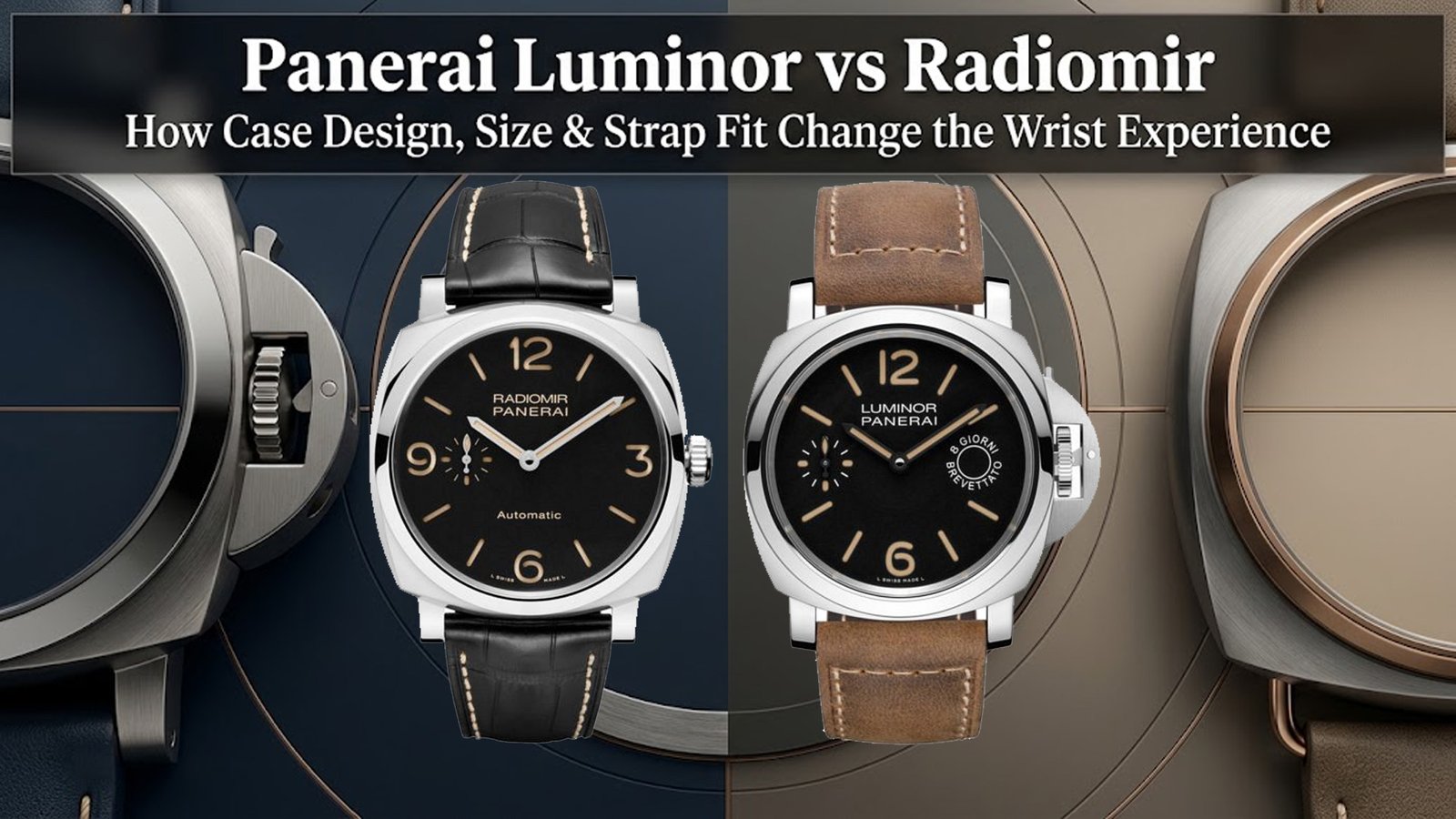
The Luminor generally delivers the more assertive Panerai wrist presence, led by its distinctive crown-protecting bridge, while the Radiomir presents a cleaner, more historically influenced case profile. Neither family has one universal size or specification, so buyers should compare the exact PAM reference, case dimensions, strap fit, condition and service history rather than choosing by diameter alone.
Luminor and Radiomir Are Families, Not Single Watch Specifications
One of the easiest mistakes to make when shopping for a pre-owned Panerai watch is to talk about “the Luminor” or “the Radiomir” as though every reference has identical proportions.
They do not.
Panerai currently presents Luminor references in several sizes, with official examples including 40mm, 44mm and 47mm watches. The current Radiomir range likewise contains different proportions; Panerai lists Radiomir examples in 40mm, 45mm and the historically influenced 47mm format.
The implication for a buyer is important: the family name tells you the design language, but the exact PAM reference tells you the watch.
| Comparison Point | Luminor | Radiomir | Why a Pre-Owned Buyer Should Care |
|---|---|---|---|
| Visual identity | Prominent crown-protecting bridge and stronger tool-watch character | Cleaner cushion-shaped profile with a more historically influenced appearance | Case architecture affects both wrist presence and where wear is likely to appear |
| Current size examples | Includes 40mm, 44mm and 47mm references | Includes 40mm, 45mm and 47mm references | Do not assume a family name automatically means “large” |
| Wrist impression | Usually more architectural and visually substantial | Often visually cleaner around the crown side | Diameter alone cannot predict fit |
| Strap influence | Strap thickness and taper can reinforce the watch’s substantial profile | Strap choice can materially alter the vintage or contemporary character | Check that the supplied strap, buckle and sizing work for your wrist |
| Pre-owned inspection | Crown guard, lever, case edges, strap attachment and polishing deserve attention | Case geometry, crown, lugs, strap attachment and polishing deserve attention | Different architecture creates different condition questions |
Why Case Diameter Is Only the Beginning
Watch buyers often use diameter as shorthand for fit: 40mm should wear smaller than 44mm, and 44mm should wear smaller than 47mm. It is a useful starting point, but with Panerai it is not enough.
A Luminor has a substantial visual structure around the crown side of the watch. Panerai itself describes the Luminor through its recognisable crown-protecting device, and current models continue to use that architecture.
The Radiomir removes that particular visual mass and brings a different case and crown relationship. That can change the way a similarly sized watch feels even before strap choice is considered.
Buyer insight: When comparing two Panerai watches, record the reference numbers first and diameter second. A PAM number lets you verify the actual case, movement, material and strap specification instead of relying on assumptions about the wider collection.
How 40mm, 44–45mm and 47mm Panerai Watches Tend to Fit Different Buyers
40mm: easier integration into everyday wear
A 40mm Panerai can make sense for someone who likes the brand’s unmistakable design but does not want the watch to dominate the wrist. This size can work particularly well with business clothing, regular office wear or a buyer moving into Panerai from more conventional sports watches.
It should not automatically be described as a “small Panerai”. Wrist shape matters. A flatter wrist can support more watch than its circumference suggests, while a rounder wrist of the same measurement may experience the same case differently.
44mm and 45mm: the central Panerai experience for many buyers
The 44mm Luminor and 45mm Radiomir formats are useful places to begin when someone wants obvious Panerai character without automatically moving to the largest historic proportions. Current official examples include 44mm Luminor models and 45mm Radiomir models.
At these dimensions, strap choice becomes especially important. A thick, stiff strap can make a watch feel more substantial, while a well-shaped strap in the correct length can seat the same case more comfortably.
47mm: buy it because it fits, not because it is the largest
Panerai continues to offer 47mm references in both the Luminor and Radiomir families.
The right 47mm Panerai can be extremely satisfying for someone who genuinely enjoys the historical proportions and has the wrist shape to support them. Buying one merely because it appears to be the “most Panerai” choice, however, can produce an expensive watch that spends too much time off the wrist.
Try to assess where the lugs sit, whether the watch moves excessively, whether the crown area presses against the hand, and whether the strap reaches a comfortable hole without leaving an awkward amount of tail.
Inspect the Case Differently on a Luminor
With a pre-owned Luminor, the crown-protecting structure deserves specific attention. Look at the bridge, lever, surrounding case surfaces and the relationship between polished or brushed finishes specified for the exact reference.
Do not assume every softened edge is normal ageing. Repeated refinishing can alter geometry, particularly on a watch whose visual character depends heavily on case shape.
At the same time, do not judge an honest, lightly worn watch more harshly than a heavily refinished example simply because the latter appears shinier in photographs. The wider principles explained in the site’s watch condition grading guide are particularly relevant here: cosmetic freshness and structural preservation are not the same thing.
What to Inspect on a Pre-Owned Radiomir
For a Radiomir, inspect the shape of the case, crown, lug arrangement and the points where the strap interfaces with the watch. Pay attention to symmetry, unnecessary rounding from polishing, obvious tool marks, damaged screws where applicable, and whether the fitted strap and buckle correspond sensibly with the reference being offered.
Some buyers are drawn to Radiomir precisely because of its cleaner historical aesthetic. That makes condition more, not less, important. A simple case gives poorly executed refinishing fewer places to hide.
Collector insight: An older Panerai with honest surface wear can be more interesting than an aggressively refinished example. Condition should be assessed alongside originality and case geometry, not reduced to whether the watch looks newly polished.
Strap Fit Is Part of the Purchase, Not an Afterthought
Panerai’s own strap guidance distinguishes attachment width, buckle width and multiple strap lengths, including Standard and Extra Large, with Extra Small available for some straps.
That matters when evaluating a pre-owned example. Check:
- whether the strap is an original Panerai item, a correct replacement or an aftermarket strap;
- whether the buckle is correct for the watch and material;
- the physical condition of the strap around holes and attachment points;
- whether the supplied length actually fits your wrist;
- whether additional straps or buckles included in the set were originally supplied or acquired later.
An aftermarket strap is not automatically a problem. Many Panerai owners enjoy changing straps. The issue is disclosure and value. A buyer should know what is original, what has been replaced and what is simply an additional accessory.
Do Not Generalise the Movement Specification
Luminor and Radiomir references have been produced with different movements, functions and power reserves. Even within current production, Panerai offers hand-wound and automatic watches and different complication layouts. For example, the current Radiomir PAM01348 is a 45mm hand-wound eight-day model, while other references use entirely different calibres and specifications.
Before buying, confirm the PAM reference and then verify:
- the correct calibre;
- manual or automatic winding;
- the functions fitted to that reference;
- expected power-reserve specification;
- service documentation;
- any known replacement components.
If the watch has been serviced, ask what work was actually undertaken. “Recently serviced” is less useful than an invoice showing the date, provider and scope of work. The site’s guide to verifying watch service history explains why that distinction matters.
Originality, Service Parts and Modifications
A pre-owned Panerai does not need to remain untouched forever to be a good watch. Mechanical watches require maintenance. Straps wear. Gaskets age. Components may be replaced legitimately during service.
The important question is whether those changes have been understood and disclosed.
Ask whether the dial, hands, bezel where applicable, crown, crystal, movement components, strap and buckle are believed to be original to the watch or later replacements. If the watch has undergone cosmetic modification, DLC/PVD treatment not original to the reference, aftermarket gem-setting or other significant changes, factor that into the purchase rather than treating it as a standard example.
How Full Set Status Should Influence the Decision
Box, warranty documentation, booklets, receipts, service papers and spare straps can improve completeness, but they do not replace examination of the physical watch.
For a collector-focused reference, a strong full set may make the example easier to understand and potentially easier to resell later. For a watch intended primarily for regular wear, a well-priced watch-only example may still be entirely sensible if authenticity, condition and history have been assessed properly.
Buyers who are still building their pre-owned evaluation process can also review the broader pre-owned luxury watch buying guide.
Which Should You Choose: Luminor or Radiomir?
Choose a Luminor if the crown-protecting bridge, stronger architectural presence and unmistakable Panerai profile are central to what attracts you to the brand.
Choose a Radiomir if you prefer a cleaner case silhouette, historical character and a slightly less mechanically assertive appearance on the crown side.
Neither answer is universally better.
A strong purchase is the reference that works on your wrist and survives close inspection. If a 40mm Luminor fits you perfectly, there is no reason to buy a 47mm watch merely to satisfy somebody else’s idea of Panerai proportions. Conversely, a well-proportioned 47mm Radiomir can be exactly right for a buyer who deliberately wants that historical scale.
Frequently Asked Questions
Does a 45mm Radiomir wear the same as a 44mm Luminor?
No. Diameter is only one dimension. The Luminor’s crown-protecting bridge, case shape, lugs, strap and the exact reference all influence wrist presence, while a Radiomir uses a different architecture.
Is a 40mm Panerai too small for the brand?
No. Panerai currently produces 40mm watches, and the appropriate size depends on the reference, wrist and intended use.
Should I avoid a polished pre-owned Panerai?
Not automatically. The important questions are how much material was removed, whether original geometry and finishing remain convincing, and whether the seller has represented the condition accurately.
Are aftermarket Panerai straps a problem?
Not necessarily. Strap changing is common among Panerai owners. A buyer should simply understand whether the original strap and buckle are present and whether the current setup affects completeness or resale appeal.
Do box and papers prove a Panerai is authentic?
No. Documentation can support ownership history and completeness, but authentication requires examination of the physical watch, reference information, components and movement where appropriate. For a high-value purchase, qualified professional inspection remains the sensible approach.
Should I buy a Luminor or Radiomir for everyday wear?
That depends on wrist fit and lifestyle rather than the family name alone. Try the exact reference, check how the crown and strap interact with your wrist, and consider how often the watch will be worn with business clothing, casual clothing or more active use.
Discuss Your Panerai Requirements
If you are comparing a particular Luminor or Radiomir, begin with the PAM reference, case material, size, condition, service history, box and papers, strap and buckle details. You can review available Panerai watches in Dubai or discuss a specific pre-owned example with Buy & Sell Watches before deciding which configuration suits your wrist and ownership plans.