 +971 58 515 9269


Selling a Luxury Watch With Aftermarket Components in Dubai: What Owners Should Disclose

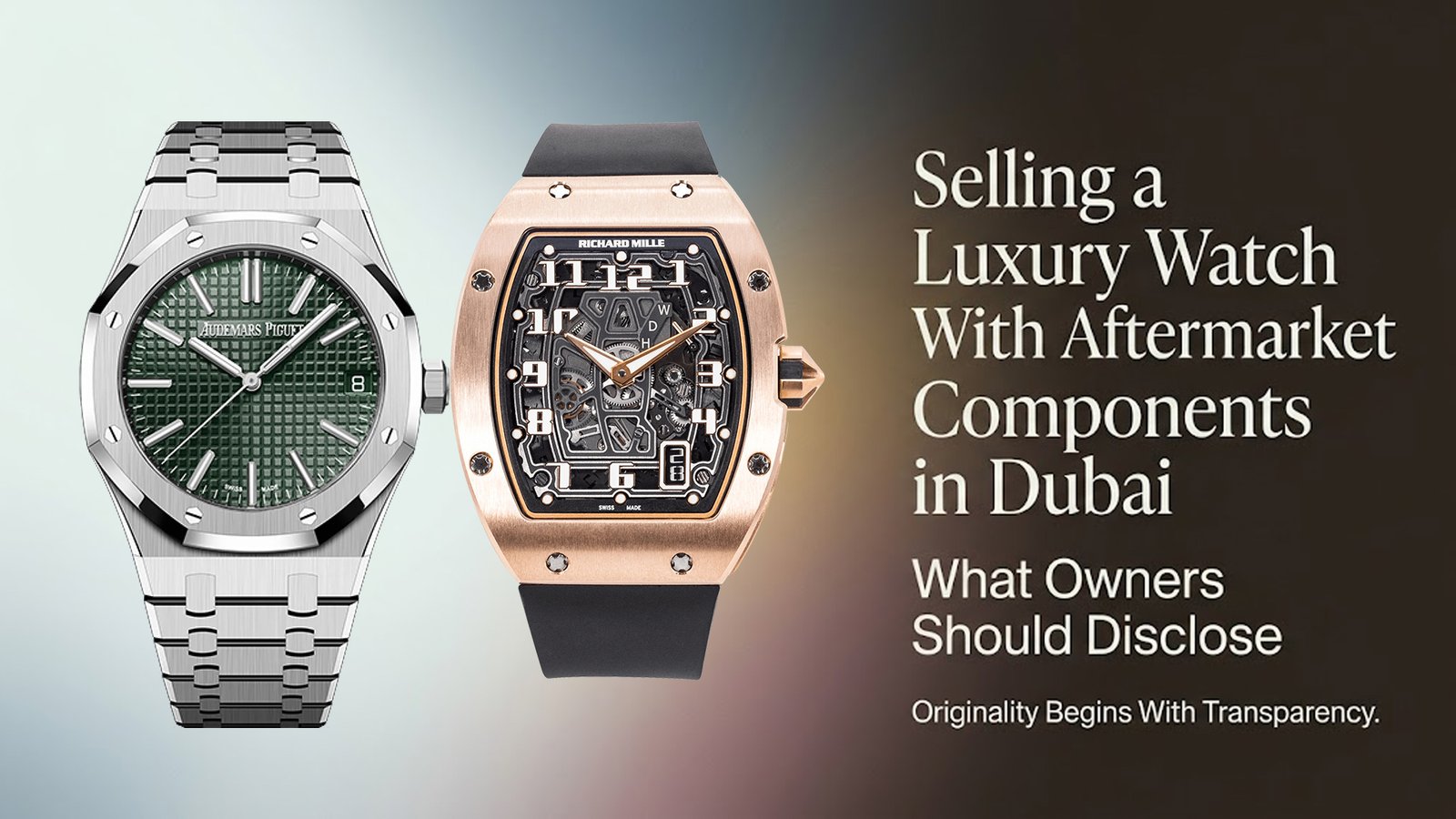
Modified Rolex, Cartier or AP? What You Reveal Before Selling Can Change the Entire Negotiation
Owning a modified luxury watch is not unusual. Some watches receive replacement straps or genuine service components during normal ownership, while others are deliberately customized with aftermarket diamonds, different dials, bezels or other decorative elements.
However, when the time comes to sell, those changes can affect how the watch is assessed.
For anyone looking to sell a modified luxury watch in Dubai, the essential starting point is transparency. A potential buyer needs to understand which components are factory-original, which were replaced during servicing and which were fitted by an independent third party.
These distinctions can influence buyer interest, the inspection process and the terms of an eventual offer. Importantly, not every replacement part is an aftermarket modification, and a modified watch does not automatically become impossible to sell.
This guide explains how to identify and document changes, prepare a watch for evaluation and approach the selling process without making unsupported claims about originality or resale value.
- What Counts as an Aftermarket Luxury Watch Modification?
An aftermarket modification generally refers to a change made to a watch outside its original manufacturer-supplied configuration, particularly when it involves third-party components or customization work.
The term covers a wide range of alterations, but these should not all be treated identically.
Common examples include:
- Aftermarket diamond settings: Diamonds added to a case, bezel, dial or bracelet outside the manufacturer’s original configuration.
- Replacement dials: A dial fitted after the original sale, which may be genuine, service-supplied or aftermarket depending on its source.
- Custom bezels: Replacement bezels or decorative treatments not supplied in the original configuration.
- Third-party bracelets: Non-original bracelets or clasps fitted to the watch.
- Decorative case treatments: Non-factory coating, engraving or other external alterations.
- Movement modifications: Changes to the original mechanism or installation of non-standard mechanical components.
A replacement leather strap or a routine manufacturer service component should not automatically be described as the same kind of modification as a diamond-set aftermarket bezel.
Accurate terminology matters because these changes can carry very different implications for originality and future maintenance.
- Factory-Original, Genuine Service and Aftermarket Components
Before requesting a luxury watch resale valuation in Dubai, owners should distinguish three important component categories.
| Component Category | Meaning | What Sellers Should Disclose |
| Factory-original | Components supplied in the watch’s original manufacturer configuration. | Provide supporting reference details and original documentation where available. |
| Genuine service replacement | A genuine manufacturer component installed during maintenance or repair. | Explain what was replaced and supply service records where available. |
| Aftermarket modification | A third-party component or alteration outside the original manufacturer configuration. | Identify the modification, available supporting records and any known original parts. |
These categories are not interchangeable.
A watch fitted with genuine replacement hands during manufacturer servicing is not necessarily equivalent to a watch fitted with an independently manufactured custom dial.
Likewise, a watch with manufacturer-supplied factory-set diamonds should not be presented as identical to a watch decorated by an independent aftermarket diamond setter.
The visual appearance may be similar, but the production history and component identity are different.
- Selling a Rolex With Aftermarket Diamonds
A common seller question concerns whether a Rolex with aftermarket diamonds can be resold.
The answer depends on the particular watch, the nature of the modifications and whether a potential buyer is prepared to consider that configuration.
It would be misleading to claim that aftermarket diamonds always increase a Rolex’s resale value because diamonds have been added.
Similarly, it would be inaccurate to assume that every modified Rolex has no resale market.
Some buyers may appreciate a particular customized appearance, while others prefer watches with documented original factory configurations.
What Should a Rolex Seller Disclose?
If you own a modified Rolex, prepare details about:
- The original Rolex reference number.
- The dial currently fitted to the watch.
- Whether any diamonds were originally factory-set or added later.
- Any aftermarket bezel or bracelet components.
- Known modifications to the case or movement.
- Whether removed original components are still available.
- Relevant invoices, service documents or customization records.
A clear explanation can help a buyer understand the watch without making assumptions from photographs.
For additional information about component history, read the Rolex service parts versus original parts guide.
- Aftermarket Cartier, Audemars Piguet and Other Luxury Watches
Customization is not limited to Rolex.
Cartier watches may feature aftermarket diamond settings, replacement dials or non-standard bracelets. Audemars Piguet watches can also be found with customized cases, bezels, dials or straps.
These alterations should be examined against the correct original reference.
Cartier: Why the Original Configuration Matters
Cartier produces both diamond-set and non-diamond versions across various collections.
A watch featuring diamonds is therefore not automatically an aftermarket example.
The seller should establish whether the diamonds correspond to a documented Cartier factory configuration or were added separately.
Where a watch has been customized after its original sale, that history should be stated clearly.
You can explore the Cartier watch collection to understand the variety of models and configurations represented in the secondary market.
Audemars Piguet: Modifications to Distinctive Case Designs
Audemars Piguet Royal Oak and Royal Oak Offshore watches have recognizable case geometry, bezels and finishing details.
Modifications to these elements can affect the watch’s original appearance and may influence how a buyer evaluates its condition.
A customized bezel or diamond setting should be disclosed rather than presented as a manufacturer-original configuration without supporting evidence.
The same principle applies to non-original dials, bracelets and other components.
- Can Aftermarket Modifications Affect Resale Value?
Yes, aftermarket changes can affect the offers a seller receives, but their impact is not governed by a universal percentage.
The outcome depends on the brand, original reference, extent of modification, quality of workmanship, condition and preferences of potential buyers.
Several factors can influence the assessment.
Originality and Buyer Preferences
Some collectors prioritize factory-original configurations and may be less interested in a heavily customized example.
Other buyers may seek a particular modified appearance.
These preferences mean that aftermarket customization can change the audience interested in the watch rather than producing a predictable increase in demand.
Condition and Workmanship
The quality of modification work matters.
Poorly executed changes can create concerns about the condition of the case, dial or other components.
For example, modifications that involve cutting, drilling or otherwise altering an original part may deserve more scrutiny than a reversible strap replacement.
The potential cost and practicality of returning a watch to its earlier configuration should also be considered.
Missing Original Components
If the original dial, bezel or bracelet has been removed, the owner should establish whether those components are still available.
Returning a modified watch to its original configuration may not be possible or economically sensible in every case.
Even where original components are retained, their condition and suitability should be checked before assuming they can simply be refitted.
Documentation
Invoices or records describing modification work may help clarify what was changed and when.
Such paperwork does not automatically prove that a watch is authentic or that the modification was appropriate, but it can support a more transparent evaluation.
For further reading, the luxury watch provenance guide explains the importance of a documented ownership and component history.
- Will the Manufacturer Service a Modified Watch?
Owners should not assume that every manufacturer will accept every modified watch for all types of service.
Manufacturer policies, service eligibility and repair options vary. The nature of the aftermarket modification can also affect the work that is technically possible or commercially available.
Before selling, it can be useful to establish whether the watch has outstanding maintenance requirements and whether those requirements have been assessed by an appropriate watch professional.
If previous service requests were declined or additional work was recommended because of modifications, disclose that information when relevant.
Do not promise that the manufacturer will restore the watch, remove every aftermarket component or return it to original condition without confirmation from the relevant service provider.
- How to Prepare a Modified Luxury Watch for Sale in Dubai
Preparing a modified watch for resale is largely an exercise in assembling accurate information.
A structured approach can reduce confusion during an initial evaluation.
Step 1: Identify the Exact Watch Reference
Record the brand, collection, reference number and any known production or purchase information.
Do not describe a customized watch solely by the appearance of its aftermarket dial or bezel. Its original model identity remains important.
Step 2: List Every Known Modification
Prepare a straightforward description of changes to the dial, hands, bezel, case, bracelet, clasp and movement.
If you are uncertain whether a component is original, state that its origin has not been verified.
Guessing or making an unsupported authenticity claim can create unnecessary complications later in the selling process.
Step 3: Photograph the Actual Watch
Take clear photographs of the watch from several angles.
Useful images include:
- Full front view showing the dial and bezel.
- Side views showing the case and crown.
- Bracelet or strap and clasp details.
- Close-ups of any customized diamond settings.
- Visible areas affected by alterations.
- Available box, papers and relevant accessory items.
Photographs should accurately show the watch’s condition. Avoid editing images to conceal scratches, damage or details of the customization.
Share sensitive identifying information only through appropriate channels and avoid unnecessarily publishing complete serial numbers in public listings.
Step 4: Gather Original and Customization Documents
Collect any available warranty information, original purchase records, service invoices, modification invoices and related documents.
If the original components were retained, photograph them separately and explain their known history.
Step 5: Identify Any Outstanding Mechanical Issues
Make a note of any problems with timekeeping, winding, date changes, chronograph functions or other complications.
Do not assume that cosmetic changes have no possible relationship to mechanical condition, particularly if the watch was opened or structurally altered.
Step 6: Request an Evaluation Based on the Actual Configuration
Present the watch as it currently exists.
Ask the prospective buyer or dealer whether that specific modified configuration is eligible for consideration and what supporting information is required.
Submitting accurate details does not guarantee an offer, a particular valuation or acceptance of the watch.
- Should You Restore the Watch Before Selling It?
Restoring a modified watch to a previous configuration may seem like an obvious way to improve resale prospects.
However, it should not be undertaken without understanding the possible cost, component availability and technical implications.
Some alterations are relatively straightforward to reverse. Others involve permanent changes to original components.
A professional assessment can help determine whether restoration is practical and whether the potential benefit justifies the expense.
For example, replacing an aftermarket strap with an appropriate original strap is a different task from addressing modifications to a diamond-set bezel or altered case.
Owners should avoid paying for unnecessary work based only on the assumption that restoration will produce a higher resale offer.
- Direct Sale vs Trade-In: Which Is Better for a Modified Watch?
The decision between selling and trading a customized watch depends on the options actually available for that watch.
A direct sale involves transferring the watch in exchange for an agreed payment. A trade-in involves using its agreed value toward another purchase.
Neither arrangement guarantees a better outcome.
For modified examples, the first issue is whether the prospective buyer or dealer is willing to consider the specific configuration.
Only then does it make sense to compare the financial terms.
If both options are available, establish the net value of each arrangement, including any additional payment required for a trade.
For a deeper comparison, read the luxury watch trade-in vs direct sale guide.
- How to Approach Buy & Sell Watches About a Modified Timepiece
Buy & Sell Watches provides an enquiry route for owners interested in selling or trading luxury watches in Dubai.
If your watch contains aftermarket modifications, begin by explaining the exact reference, known changes and available documentation.
You can submit an enquiry through the Sell or Trade Watches page.
Because the suitability of a modified watch depends on its individual configuration, the team should be contacted directly to confirm whether it can be considered and what additional information may be required.
An enquiry should not be interpreted as a guaranteed offer, guaranteed acceptance or confirmation of a particular resale price.
Frequently Asked Questions
Can I sell a Rolex with aftermarket diamonds in Dubai?
A modified Rolex may be considered by some buyers, depending on its specific configuration, condition and the buyer’s requirements. Acceptance and the amount of any offer cannot be assumed.
Do aftermarket diamonds increase the resale value of a Rolex?
Not necessarily. Their effect depends on the watch, quality of customization, buyer preferences and current market circumstances. There is no universal rule that added diamonds increase resale value.
Are genuine Rolex service parts considered aftermarket?
Genuine components fitted during manufacturer servicing should be distinguished from independently manufactured aftermarket parts. Both the component’s origin and replacement history may be relevant to a buyer.
Can I sell a Cartier watch with aftermarket diamonds?
Potential resale interest depends on the model, modifications and the requirements of the prospective buyer. The seller should clearly distinguish factory-set diamonds from later aftermarket settings.
Should I remove aftermarket components before selling?
Not automatically. Removal or restoration can involve expense, technical limitations and possible risks to original components. Obtain an appropriate assessment before authorizing changes.
Where can I request an evaluation for a modified luxury watch in Dubai?
You can use the Buy & Sell Watches selling enquiry page or contact the team directly to explain the watch’s configuration and ask whether it can be considered.
Conclusion: Transparency Is Essential When Selling a Modified Watch
Anyone planning to sell an aftermarket luxury watch in Dubai should begin with a clear understanding of the watch’s original reference and subsequent modifications.
Factory-original components, genuine service replacements and aftermarket alterations have different meanings. Accurate disclosure helps potential buyers evaluate the watch without confusing those categories.
There is no guaranteed resale advantage or disadvantage that applies to every modified Rolex, Cartier, Audemars Piguet or other luxury watch.
Instead, prepare a reliable description, disclose known changes, gather available documents and request an evaluation based on the watch’s actual condition and configuration.
Ready to discuss your watch? Visit the Sell or Trade Luxury Watches page or contact Buy & Sell Watches in Downtown Dubai to submit the details of your timepiece and enquire about available options.