 +971 58 515 9269

Pre-Owned Patek Philippe Aquanaut Inspection Guide: Strap, Clasp, Case, Service History & Completeness

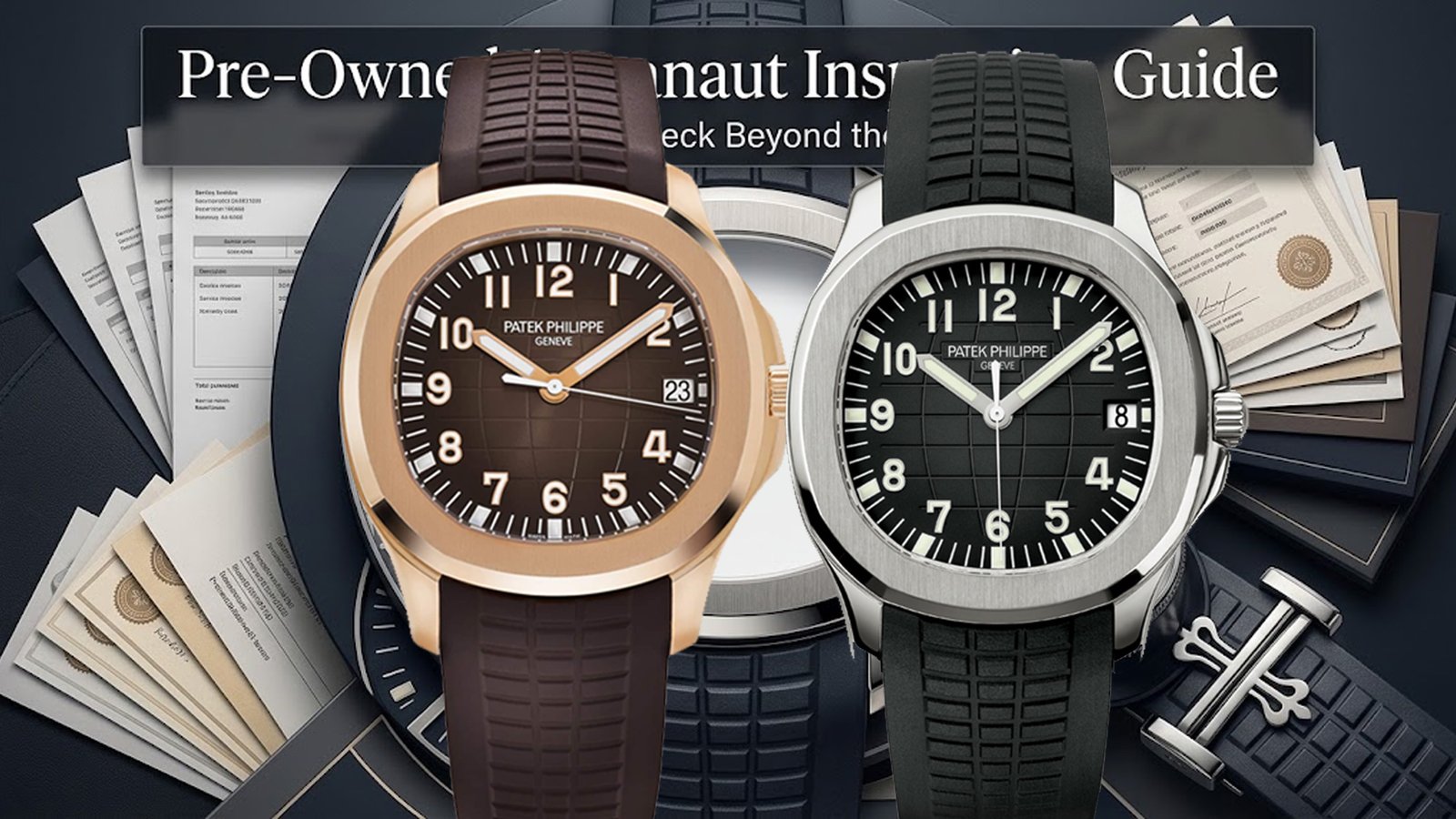
Before buying a pre-owned Patek Philippe Aquanaut, confirm the exact reference and material, inspect the case finishing, dial, hands, crown, composite strap and correct clasp, and review service history and documentation. Box and papers can support completeness, but they do not replace physical authentication or a reference-specific examination of the watch.
Start With the Exact Reference, Not “Aquanaut”
The Aquanaut is a collection containing substantially different watches. Patek Philippe’s current collection includes steel and precious-metal references, time-only/date models, Travel Time watches, chronographs and Aquanaut Luce configurations.
That is why a listing described simply as “Patek Aquanaut” is not enough.
Ask for the complete reference before discussing value. The reference establishes the correct case material, dimensions, movement, clasp material, dial configuration and strap specification against which the physical watch can be compared.
For example, Patek Philippe lists the Ref. 5167A-001 with a 40.8mm steel case, black composite strap and steel patented fold-over clasp. Ref. 5168G-001 is a different proposition: its case is white gold, measures 42.2mm, and its matching clasp is also white gold.
Those differences are not trivia. They determine what should physically be on the watch.
| Inspection Area | What to Confirm | Why It Matters |
|---|---|---|
| Reference | Full reference and material configuration | Establishes the correct specification for every later check |
| Case | Geometry, polished/satin transitions, dents, refinishing and crown condition | Heavy refinishing can alter the appearance of the original case architecture |
| Dial and hands | Correct configuration and condition for the reference | Replacement or modified components can affect collector desirability |
| Composite strap | Correct style, condition and suitable sizing | A heavily worn or incorrectly fitted strap changes the real cost of ownership |
| Clasp | Correct material and design for the reference | The clasp is an important, high-value component of the configuration |
| Movement and functions | Correct calibre, operation and service status | A complication must work correctly, not simply appear correct externally |
| Documentation | Warranty papers/card, receipts, service invoices and seller records | Supports completeness and provenance but does not independently authenticate the watch |
The Case Deserves More Attention Than a Listing Photograph Usually Gives It
The Aquanaut’s rounded-octagonal case and bezel use contrasting polished and satin-brushed surfaces as part of the design. Patek Philippe itself highlights this combination within the collection.
That makes case condition particularly important.
Examine:
- the edges and transitions between different finishes;
- whether the case shape remains even and convincing;
- impact marks around the bezel and case sides;
- scratches that are consistent with normal wear versus deeper damage;
- the crown and surrounding surfaces;
- signs of repeated or overly aggressive refinishing.
A polished Aquanaut is not automatically undesirable. The concern is the quality and extent of the work. Refinishing intended to remove every trace of wear can also remove material and soften details that matter to an experienced buyer.
Collector insight: On an Aquanaut, “looks very clean” and “is exceptionally well preserved” are not necessarily the same statement. A buyer should distinguish careful ownership from cosmetic refinishing.
Inspect the Composite Strap as Part of the Watch
The Aquanaut’s composite strap is integral to its identity. Patek Philippe describes the material as supple, resistant to wear, salt water and UV exposure, and current references pair it with different fold-over clasps depending on the watch’s case material.
For a pre-owned watch, inspect the strap carefully rather than treating it as disposable packaging.
Look for:
- cracking, distortion or unusual hardening;
- excessive wear near the clasp;
- damage or tearing around attachment points;
- whether the strap fits your wrist comfortably;
- whether an additional strap is included;
- whether the strap is an original Patek Philippe component or aftermarket replacement.
Patek Philippe publishes replacement pricing for composite straps as part of its service information, which reinforces the simple point that replacement is a real ownership cost rather than an invisible detail.
The Clasp Can Reveal More Than Buyers Expect
Do not inspect an Aquanaut strap while ignoring the clasp attached to it. The clasp should be checked against the exact reference and case material. Patek uses reference-appropriate fold-over clasps across the Aquanaut family; a steel 5167A, for example, is specified with a steel clasp, while precious-metal versions use corresponding precious-metal clasps.
Check the clasp for:
- correct material and design;
- secure operation;
- damage to pushers or locking components;
- deep impacts or deformation;
- excessive polishing;
- clear disclosure if it has been replaced.
A replacement clasp is not necessarily evidence of a problem, but at this value level the buyer should know what has been changed and why.
Dial and Hands: Correctness Matters More Than Brightness
The dial should be assessed against the reference rather than against a generic image of an Aquanaut. Look at the dial colour, texture, numerals, hands, date display and any complication indications specific to the model.
Do not assume a watch is correct simply because individual elements look professionally made. High-value watch authentication is cumulative. Reference consistency, movement, case, dial, hands, crown, strap, clasp, documentation and provenance should support one another.
This is where the site’s luxury watch authentication guide is more useful than simplistic “spot the fake” rules.
Check Every Complication Before Payment
An Aquanaut is not always a time-and-date watch. Current examples include Travel Time and chronograph models, while other configurations contain different complications. Patek Philippe’s official instructions are reference-specific for this reason.
If buying a complicated Aquanaut, confirm that the functions operate properly and that you understand the correct operating procedure before testing them. Do not aggressively manipulate pushers or calendar functions without knowing the watch.
If there is any uncertainty about mechanical condition, obtain professional assessment rather than treating a functioning seconds hand as proof that everything is healthy.
Service History Can Change the Quality of the Same Reference
A well-documented service can be reassuring, particularly on a complicated watch, but “serviced” should not be accepted as a complete answer.
Ask:
- when the work was performed;
- who performed it;
- whether documentation is available;
- what components were replaced;
- whether cosmetic refinishing was undertaken;
- whether water-resistance testing formed part of the work;
- whether the movement was fully serviced or only adjusted.
The site’s detailed guide to verifying service history before buying a watch is worth using alongside the physical inspection.
Buyer insight: “Recently serviced” is a description. A dated service invoice with the scope of work is evidence. Treat the two differently when comparing pre-owned watches.
Box and Papers Matter, But They Do Not Authenticate the Physical Watch
A complete Aquanaut set may include original presentation materials, warranty documentation and other accessories associated with the particular watch. These can strengthen provenance and commercial completeness.
They do not remove the need to inspect the watch itself.
Papers can be separated from watches. Accessories can be replaced. A sophisticated purchase should therefore treat documentation as one part of a larger verification process.
Similarly, an Aquanaut without its original papers is not automatically counterfeit. It simply requires more careful evaluation of the watch, ownership trail and available evidence.
Aftermarket Modifications Require Clear Disclosure
High-value watches are sometimes modified after leaving the manufacturer. Examples can include aftermarket gem-setting, non-original straps, custom-coloured components or other cosmetic changes.
Some buyers deliberately enjoy modified watches. Others will only consider manufacturer-original configurations.
Neither preference changes the seller’s obligation to describe the watch accurately. If a component or finish is aftermarket, the buyer should know before price is discussed as though the watch were an original-standard example.
How to Compare Two Aquanauts Without Falling Back on Asking Price
Imagine two watches carrying the same reference. One is slightly cheaper but has an uncertain service record, heavily worn strap, softened case surfaces and incomplete accessories. The other costs more but has stronger structural condition, documented service work and a more complete set.
The cheaper asking price does not automatically represent better value.
This is why the existing Patek Philippe Aquanaut buying page should be the starting point for model access, while detailed pre-owned inspection should determine which individual example deserves your money.
Remote Buyers Should Request More Than Front-and-Back Photographs
International collectors buying through Dubai should request a sufficiently detailed visual record before transferring substantial funds.
Useful images and information can include:
- straight-on dial photograph;
- both case flanks;
- bezel from multiple angles;
- crown;
- case back;
- strap surfaces and attachment points;
- clasp open and closed;
- documentation and service invoices;
- clear explanation of any replacement or aftermarket components.
Where appropriate, a live video inspection or independent physical assessment can close gaps that edited listing photographs cannot.
Frequently Asked Questions
Do papers prove that a Patek Philippe Aquanaut is authentic?
No. Papers can support provenance and completeness, but authentication requires examination of the actual watch and its components. For high-value transactions, qualified physical inspection is appropriate.
Is a replacement Aquanaut strap a problem?
Not necessarily. Straps are wear items. The important points are whether the replacement is correctly disclosed, whether it is original or aftermarket, and whether the overall price reflects the watch’s actual configuration.
Why should I check the clasp separately?
The clasp is a significant component and should correspond with the exact reference and material. Its condition, operation and originality can affect both ownership quality and resale desirability.
Is an unpolished Aquanaut always worth more?
No universal rule applies. An honestly preserved case can be highly desirable, but overall condition, damage, originality, service history and market demand still matter. “Unpolished” should also be supported by credible examination rather than accepted automatically.
Can two Aquanauts with the same reference have different values?
Yes. Case condition, strap and clasp condition, service history, completeness, provenance, modifications and current demand can create meaningful differences between examples carrying the same reference.
Should I buy a watch-only Aquanaut?
It can make sense if the watch is authentic, correctly priced and strong in condition, but the absence of original documentation and accessories should be considered when assessing both purchase price and future resale.
Where can I compare pre-owned Patek Philippe watches in Dubai?
You can review the current Patek Philippe watches available through Buy & Sell Watches and assess individual examples using the reference-specific checks above.
Discuss Your Aquanaut Requirements
If you are evaluating a particular Patek Philippe Aquanaut, provide the complete reference, case material, condition, strap and clasp details, service history and information about the original set. Buy & Sell Watches can then discuss the available pre-owned options in a more precise way than a general model-name enquiry allows.