 +971 58 515 9269


Hublot Classic Fusion Three-Hand vs Chronograph: A Pre-Owned Buying Comparison

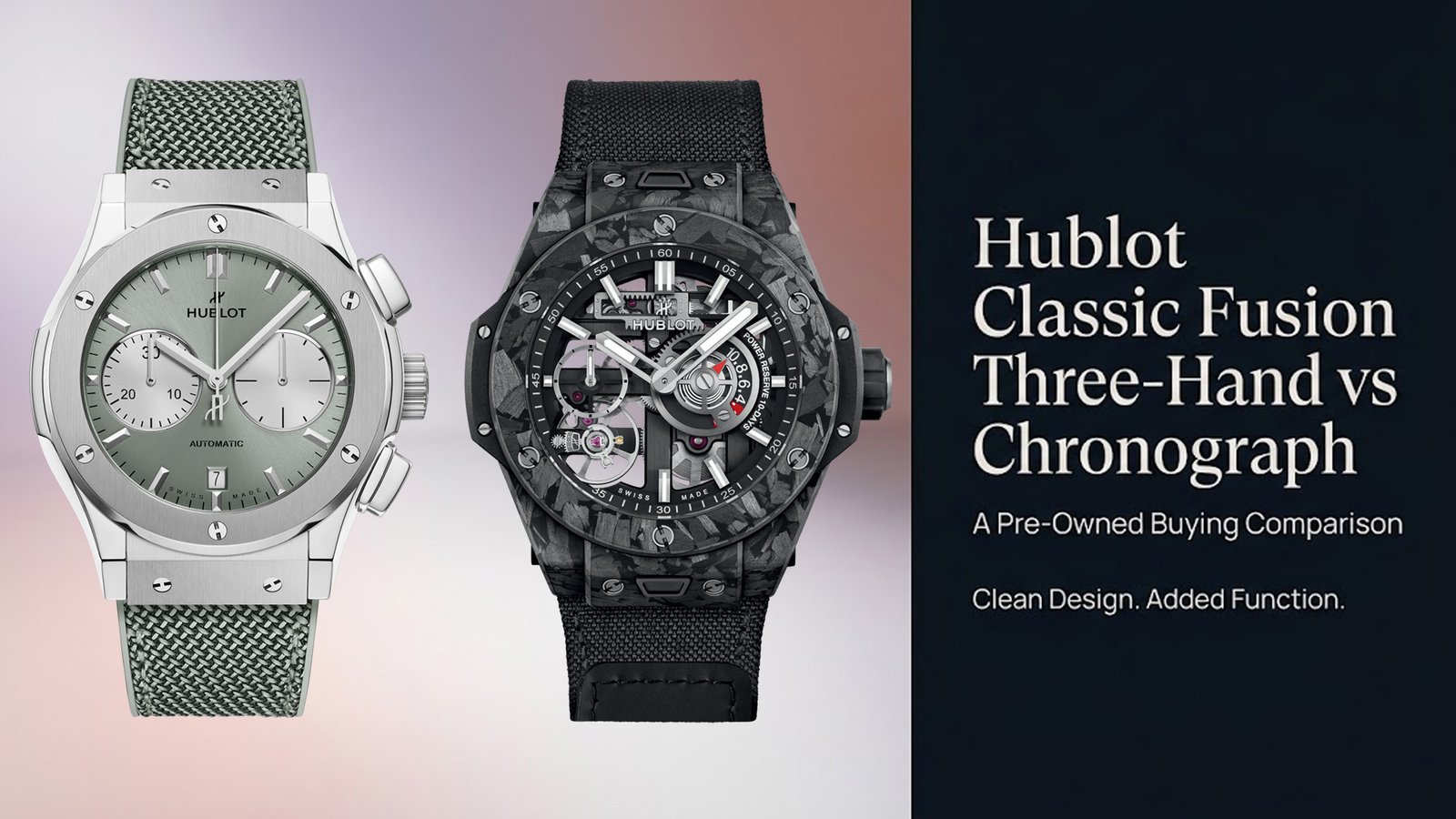
One Keeps Things Simple. The Other Adds a Stopwatch. Which Classic Fusion Is Right for You?
The Hublot Classic Fusion Automatic vs Chronograph comparison is an important decision for buyers who appreciate the collection’s recognizable design but want to understand the practical differences between its movement options.
The Classic Fusion family includes relatively simple automatic watches alongside chronographs and more complicated references. Although these models share Hublot’s distinctive bezel and case design, they should not be treated as mechanically identical.
A useful comparison is the 42 mm titanium Classic Fusion Automatic reference 542.NX.1171.RX against the 42 mm titanium Classic Fusion Chronograph reference 541.NX.1171.RX.
Both use black dials, titanium cases and black rubber straps. However, the automatic model uses calibre HUB1110, while the chronograph uses calibre HUB1153 and adds elapsed-time measurement functions.
For buyers considering pre-owned Hublot Classic Fusion watches in Dubai, the correct choice depends on whether they value a straightforward time display or want a functioning chronograph, as well as the condition and maintenance history of the particular watch.
Hublot Classic Fusion Automatic vs Chronograph: Specifications
The following table compares two manufacturer-documented 42 mm titanium references. Other Classic Fusion sizes and materials may have different technical characteristics.
| Specification | Automatic 542.NX.1171.RX | Chronograph 541.NX.1171.RX |
| Collection | Classic Fusion | Classic Fusion Chronograph |
| Case diameter | 42 mm | 42 mm |
| Case material | Satin-finished and polished titanium | Satin-finished and polished titanium |
| Bezel | Titanium with six H-shaped screws | Titanium with six H-shaped screws |
| Dial | Matte black | Matte black |
| Movement | HUB1110 | HUB1153 |
| Winding | Automatic | Automatic |
| Chronograph | No | Yes |
| Power reserve | Approximately 48 hours | Approximately 42 hours |
| Crystal | Anti-reflective sapphire | Anti-reflective sapphire |
| Water-resistance specification | 50 metres | 50 metres |
| Original strap | Black lined rubber | Black lined rubber |
| Clasp | Stainless-steel deployant clasp | Stainless-steel deployant clasp |
| Primary consideration | Simpler daily functionality | Additional chronograph operation |
These specifications apply to the named references. They should not be copied to larger 45 mm models, ceramic variants or more complicated Classic Fusion watches without checking the appropriate manufacturer information.
- Classic Fusion Automatic: An Understated Interpretation
The Hublot Classic Fusion Titanium 42mm reference 542.NX.1171.RX offers a relatively straightforward dial arrangement.
The watch emphasizes the distinctive case, exposed bezel screws and clean dial design rather than adding several chronograph counters.
Its black rubber strap contributes to the sporty appearance associated with Hublot.
Why Choose the Three-Hand Model?
The automatic version may appeal to buyers who prefer:
- A dial that is easy to read at a glance.
- A watch without chronograph pushers.
- Fewer displayed complications.
- A slightly longer published power reserve.
- A recognizable Hublot design suitable for regular wear.
The absence of a chronograph does not make the watch mechanically insignificant. It simply prioritizes ordinary timekeeping over additional elapsed-time functions.
- Classic Fusion Chronograph: More Functionality on the Dial
The Hublot Classic Fusion Chronograph adds a stopwatch function to the collection’s basic timekeeping design.
The 42 mm reference 541.NX.1171.RX uses calibre HUB1153, a self-winding chronograph movement with a manufacturer-specified power reserve of 42 hours.
The chronograph includes additional counters and external pushers, giving the watch a busier dial and a more technical appearance.
What Does a Chronograph Actually Do?
A chronograph allows the wearer to measure elapsed time separately from the ordinary time display.
The wearer starts, stops and resets the timing mechanism through its dedicated controls.
This can be useful for activities requiring short-interval timing, although many owners appreciate mechanical chronographs primarily for their engineering and visual presentation.
A chronograph should not be confused with a chronometer, which refers to a timekeeping precision certification or standard.
The two terms describe different concepts.
- HUB1110 vs HUB1153: Understanding the Movements
The automatic and chronograph references use different calibres.
Hublot identifies HUB1110 as the self-winding movement used in the 42 mm titanium automatic reference.
It provides ordinary timekeeping and has approximately 48 hours of power reserve.
HUB1153 is a self-winding chronograph movement with approximately 42 hours of power reserve.
Does the Chronograph Have a Better Movement?
The addition of chronograph functionality does not automatically mean the watch is superior.
HUB1153 provides an additional complication, but that comes with different operational and service considerations.
HUB1110 offers a simpler functional arrangement and a slightly longer published power reserve.
The more relevant question is whether the owner values elapsed-time measurement enough to justify choosing the chronograph.
For a pre-owned purchase, the actual condition of the movement matters more than assuming that a higher complication count guarantees greater value.
- Dial Layout: How to Identify the Difference Immediately
The Classic Fusion Automatic uses a relatively restrained dial with conventional time indications.
The Chronograph introduces additional elapsed-time counters and pushers.
This changes the balance of the watch’s design.
The simpler reference can feel more visually restrained, while the chronograph looks more instrument-like.
Why Dial Originality Matters
Hublot offers numerous Classic Fusion dial configurations, including different colors, materials and special editions.
Consequently, a buyer should not identify the movement solely from the collection name or a photograph of the case.
Confirm the complete reference and compare the dial against the correct manufacturer specification.
Any unexplained difference involving hands, counters or applied markers deserves further examination.
- Chronograph Inspection: What Should Work Before You Buy?
A pre-owned chronograph should be assessed more thoroughly than a watch whose only function is displaying ordinary time.
Ask for a suitable demonstration of the chronograph’s operation.
Essential Chronograph Checks
- Confirm the chronograph starts correctly.
- Check that the elapsed-time indications advance as intended.
- Verify that the chronograph stops correctly.
- Observe whether the hands return to their proper reset positions.
- Inspect the pushers for damage or unusual resistance.
- Check whether previous repairs are documented.
- Ask whether the watch has undergone appropriate technical inspection.
Do not assume that a chronograph is functioning correctly simply because its normal timekeeping hands move.
A short demonstration also cannot establish the condition of every internal component.
If there are unresolved operational concerns, an appropriate professional assessment should be considered before purchase.
- Titanium Case Construction and Finishing
Both comparison references use satin-finished and polished titanium cases.
Titanium is valued in watchmaking partly because of its relatively low density and resistance to corrosion.
However, titanium is not immune to scratches or surface damage.
The different finishes around the bezel and case should be examined carefully.
What to Inspect on the Case
- Surface damage on the titanium bezel.
- Condition of the six H-shaped bezel screws.
- Consistency of polished and satin-finished surfaces.
- Visible dents around the crown and pushers.
- Evidence of substantial previous refinishing.
- Crystal condition and external component alignment.
Prior polishing is not automatically undesirable, but inappropriate refinishing can change the manufacturer’s intended surface appearance.
Compare the actual watch against accurate photographs of the same reference.
- Rubber Straps and Deployant Clasps
Both specified references use black lined rubber straps with stainless-steel deployant clasps.
Hublot’s use of rubber straps contributes significantly to the collection’s appearance and wearing experience.
For pre-owned buyers, however, strap condition is an important practical consideration.
Rubber can deteriorate through use, age, improper storage or exposure to unsuitable substances.
What to Check Before Buying
Inspect the strap near its attachment points and around the clasp.
Look for cracks, tears, deformation or unusual stiffness.
Confirm the clasp closes securely and that the strap fits the intended wrist.
Ask whether the strap has been replaced and whether it is a genuine component suitable for the reference.
A replacement strap is not automatically a problem, but it should be described accurately.
- Water Resistance and Daily Wear
Hublot specifies 50 metres of water resistance for both titanium references used in this comparison.
This describes the manufacturer-rated design, not a recent pressure-test result for an individual pre-owned watch.
Seals, crowns, pushers and previous repairs can affect the current water resistance.
A buyer intending to expose the watch to water should seek suitable professional testing.
Chronograph pushers should not be operated underwater unless the manufacturer’s instructions explicitly permit it.
For ordinary daily wear in Dubai, proper strap sizing and comfort are also worth prioritizing.
- Why the Exact Classic Fusion Reference Matters
Hublot has produced Classic Fusion models in several sizes, materials and configurations.
A 42 mm titanium three-hand watch cannot be compared directly with a 45 mm ceramic chronograph as though the only difference were the movement.
Some references use different calibres, dial materials and strap arrangements.
Check the Full Reference, Not Just the Product Title
Buy & Sell Watches lists several Classic Fusion watches, including references within the 521 family.
These examples are not the same as the 42 mm titanium references compared in this article.
For example, the website has a Classic Fusion Chronograph 521.CQ.1420.LR.JUV18 listing, which should be evaluated according to its own 45 mm ceramic configuration.
A separate Classic Fusion 521.CM.1171.RX listing also belongs to a different configuration from the 42 mm HUB1110 watch discussed here.
These distinctions help prevent misleading technical and price comparisons.
- Comparing Classic Fusion Prices in Dubai
A meaningful Hublot Classic Fusion price comparison in Dubai requires the exact reference, not simply the collection name.
The movement, case diameter, materials, condition and completeness can all affect the asking price.
The chronograph reference may have different servicing requirements because of its additional functionality.
That does not establish a fixed difference in maintenance costs without examining the actual watches.
What Should You Compare?
- Exact model and full reference.
- Movement and complications.
- Case size and material.
- Dial, bezel and component originality.
- Chronograph operation where applicable.
- Strap and clasp condition.
- Original paperwork and service records.
- Asking price, currency and seller terms.
Advertised asking prices should not be treated as verified completed sales.
Browse the Hublot collection at Buy & Sell Watches to review current listings.
- Classic Fusion vs Big Bang: A Different Comparison
The Classic Fusion and Big Bang collections have different design identities and movement configurations.
A comparison between Classic Fusion three-hand and chronograph references should therefore not be confused with choosing between the Classic Fusion and Big Bang families.
Readers considering that broader decision can explore the Hublot Big Bang vs Classic Fusion buying guide.
For wider pricing context, see the Hublot watch pricing guide for Dubai.
- Which Classic Fusion Should You Choose?
Choose the three-hand automatic if: you prefer a clean dial, straightforward daily functionality and a slightly longer published power reserve.
Choose the chronograph if: you appreciate additional elapsed-time functionality, chronograph counters and a more technical dial presentation.
Choose based on the individual watch if: condition, originality, service documentation or correct strap components differ significantly.
Neither movement type guarantees a better resale result or a universally superior ownership experience.
Frequently Asked Questions
What is the difference between Hublot Classic Fusion Automatic and Chronograph?
The automatic three-hand model focuses on conventional timekeeping, while the chronograph adds elapsed-time measurement with additional counters and pushers.
What movement is used in Hublot Classic Fusion 542.NX.1171.RX?
It uses Hublot calibre HUB1110, a self-winding movement with approximately 48 hours of power reserve.
What movement is used in Hublot Classic Fusion Chronograph 541.NX.1171.RX?
It uses calibre HUB1153, a self-winding chronograph movement with approximately 42 hours of power reserve.
Are both Classic Fusion references 42 mm?
Yes. The specific titanium references 542.NX.1171.RX and 541.NX.1171.RX are both 42 mm watches. Other Classic Fusion models have different dimensions.
Does a Hublot chronograph cost more to service?
A chronograph introduces additional mechanical functions, but actual servicing costs depend on the reference, movement condition, required repairs and service provider. A universal price difference should not be assumed.
Where can I buy pre-owned Hublot Classic Fusion watches in Dubai?
Browse the Hublot collection at Buy & Sell Watches or request an appointment to enquire about a particular reference.
Final Verdict: Choose the Functionality You Will Appreciate
The Hublot Classic Fusion Automatic vs Chronograph decision is primarily about timekeeping preferences and the ownership implications of additional functionality.
The three-hand reference offers a relatively simple dial and an approximately 48-hour power reserve. The chronograph adds elapsed-time measurement and uses a different calibre with an approximately 42-hour reserve.
For a pre-owned purchase, accurate reference identification, movement operation, case condition, strap originality and maintenance history should guide the decision.
Explore Hublot Classic Fusion watches: Browse the Hublot collection in Dubai or contact Buy & Sell Watches to discuss available models.