 +971 58 515 9269


Selling Multiple Luxury Watches in Dubai: Individual Offers vs a Collection Sale

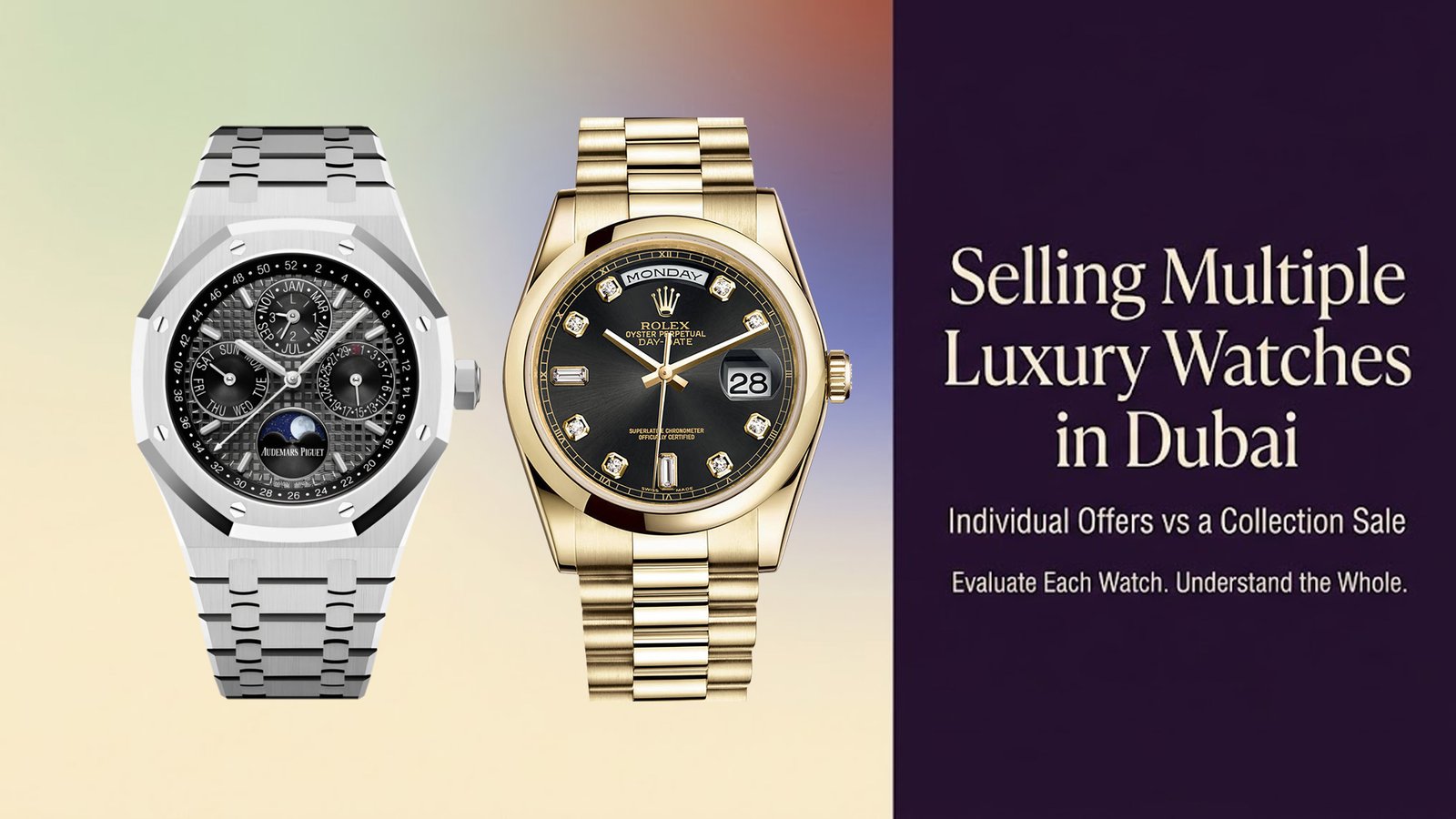
One Buyer for Everything or Separate Buyers for Each Watch? The Decision That Could Change Your Final Sale
Planning to sell a luxury watch collection in Dubai involves decisions that do not arise when selling a single watch. Whether you own three Rolex watches, several Patek Philippe references or a mixed collection built over many years, the process requires careful organization and an understanding of how individual watches may be evaluated.
One of the first decisions is whether to seek offers for each watch separately or explore the possibility of selling several watches together.
A combined transaction may offer practical convenience, but that does not guarantee the strongest total financial outcome. Individual sales can provide more flexibility, although they may involve additional time, negotiation and coordination.
The best approach depends on the watches, their condition, documentation, buyer interest and your priorities as a seller.
This guide explains how to organize a collection, evaluate different selling approaches and prepare accurate information before requesting offers in Dubai.
- Is Selling a Watch Collection Different From Selling One Watch?
Yes. A multi-watch sale introduces several additional considerations.
Every watch has its own reference, condition, service history and potential audience. The fact that two watches belong to the same collection does not mean they will receive similar offers.
A seller may own a desirable Rolex sports reference alongside a more specialist complicated watch. These pieces can attract different buyers and may require different levels of inspection.
When several watches are involved, the seller also needs to consider the total value offered, the terms of the transaction and the time required to complete each sale.
Why a Collection Needs Individual Evaluation
A collection should not be treated as one uniform asset.
Each watch must be identified and evaluated on its own merits before a combined offer can be assessed meaningfully.
Important differences include:
- Brand and complete reference number.
- Case material and original configuration.
- Physical condition and previous polishing.
- Movement type and complications.
- Service history and outstanding maintenance.
- Original box, papers and additional accessories.
- Known replacement or aftermarket components.
- Current buyer interest in that particular reference.
These details can influence both the evaluation of the individual watch and the total terms of a proposed collection sale.
- Individual Sales vs One Collection Sale: The Main Differences
There are advantages and disadvantages to both approaches.
| Consideration | Individual Watch Sales | Combined Collection Sale |
| Number of negotiations | Potentially several | Potentially fewer |
| Pricing approach | Each watch evaluated separately | Combined proposal may be considered |
| Time commitment | Can require more coordination | May simplify coordination |
| Buyer suitability | Different buyers for different references | Requires a buyer interested in the group |
| Flexibility | Individual watches can be retained or sold | Depends on the proposed terms |
| Total financial result | Not guaranteed to be higher | Not guaranteed to be higher |
| Documentation | Needed for each watch | Still needed for each watch |
A combined sale should not automatically be described as the faster or more profitable option.
Those outcomes depend on whether a suitable buyer is available and what the transaction terms actually provide.
- When Does Selling Watches Individually Make Sense?
Individual sales can be attractive when the watches differ significantly in reference, condition or buyer demand.
For example, a seller may own a modern Rolex Submariner, a complicated Patek Philippe and an older Cartier.
Those watches appeal to different buyer preferences and may be evaluated through different criteria.
Considering them separately gives the owner a clearer understanding of how each watch contributes to the collection’s potential sale value.
Advantages of Individual Offers
Separate offers may provide greater flexibility.
The owner can decide to sell one watch while retaining another, or compare offers from buyers interested in different references.
Individual negotiations can also make it easier to identify which watch requires additional documentation or inspection.
Potential Disadvantages
Several separate sales can involve additional communication, repeated appointments and more administrative work.
Each transaction may have different payment, inspection and handover requirements.
For an owner with limited time, these practical considerations may be important.
- When Might a Combined Collection Sale Be Preferable?
A combined sale may be worth exploring when an owner wants to reduce the number of separate negotiations.
This could be relevant when relocating, restructuring a collection or deciding to sell several watches within a particular period.
However, the owner should not assume that every luxury-watch dealer purchases entire collections or accepts every watch within a group.
Any such arrangement depends on the buyer’s interest, assessment and transaction terms.
Why a Combined Offer May Differ From Individual Offers
A buyer considering several watches together may evaluate the full group rather than treating the transaction as a simple sum of unrelated retail asking prices.
The proposal may reflect the desirability, condition and anticipated resale circumstances of each reference.
Specialist watches, unusual configurations or pieces requiring maintenance can influence the overall assessment.
This does not mean a combined offer is automatically unfair.
It means the seller needs to understand how the total figure was reached and whether its terms are preferable to the alternatives.
- Create a Proper Inventory Before Requesting Offers
The first practical step when planning to sell multiple luxury watches in Dubai is to organize a clear inventory.
Do not begin with a single estimated total for the entire collection.
Record each watch separately and include the details required for an informed assessment.
What Should the Inventory Contain?
- Brand and collection name.
- Complete reference number.
- Known year of original sale or purchase.
- Case material and dial configuration.
- Movement type and complications.
- Condition description.
- Available box, papers and accessories.
- Service and repair documentation.
- Known modifications or replacement components.
- Current ownership and sale-related documentation.
Where a detail is unknown, record it as unverified rather than guessing.
Serial numbers and personal documents should be handled carefully. Avoid publishing complete identifying information in open online listings or sending sensitive documents to unverified recipients.
- Separate Original Documents for Each Watch
Documentation becomes especially important when several watches and accessory sets are involved.
It is easy to confuse warranty cards, spare links or service invoices if everything is stored together.
Organize documents by reference and identify which accessories belong to each watch.
Original Papers and Supporting Records
Useful records can include original warranty documentation, purchase invoices, service records and evidence of known component replacements.
The absence of original papers does not automatically mean a watch is unsuitable for sale.
However, missing documentation may create uncertainty about the watch’s history.
That uncertainty should be reflected honestly during the evaluation.
For more context, read the luxury watch provenance guide.
- Assess Condition Before Combining Watches Into a Sale
Watch condition can vary considerably within one collection.
A regularly worn watch may have bracelet wear and case scratches, while another piece may have spent much of its life in storage.
Neither circumstance automatically establishes its mechanical condition.
A stored watch can still require maintenance, while a frequently worn watch may have been serviced properly.
Use the Same Condition Checklist for Every Watch
Record visible scratches, dents, previous polishing, dial concerns and bracelet or strap condition.
Check available maintenance records and note any known functional problems.
For complicated watches, the relevant chronograph, calendar or other functions may require separate verification.
A transparent description reduces confusion during negotiations.
The luxury watch condition grading guide provides a useful framework for comparing physical condition.
- Should You Service or Polish Watches Before Selling?
Not automatically.
An owner may assume that every watch must look almost new to receive a worthwhile offer.
However, cosmetic refinishing can alter original case geometry, and some buyers prefer watches that retain their existing finishes.
Similarly, servicing a complicated watch can involve substantial expense.
Before authorizing work, establish whether it is necessary and whether its likely benefits justify the cost.
When Maintenance Information Is More Useful Than Immediate Repairs
If a watch has an unresolved technical issue, it may be sensible to obtain an appropriate assessment.
That does not necessarily mean authorizing every recommended repair before exploring a sale.
The buyer may prefer to evaluate the watch in its existing condition.
Where servicing or cosmetic work has already been completed, provide the supporting records.
A recent service should be described accurately rather than assumed to establish perfect mechanical condition.
- Factory-Original and Modified Watches Should Be Identified Separately
Some collections include watches fitted with aftermarket diamonds, replacement dials or other modifications.
These pieces should be documented individually.
A factory-original watch should not be described as equivalent to a heavily modified example simply because the underlying brand and reference are the same.
Similarly, genuine manufacturer service components should be distinguished from independently manufactured aftermarket parts.
Disclose known alterations and provide supporting records where available.
Doing so helps potential buyers assess each watch on its actual configuration.
- How to Compare Multiple Watch Offers Properly
The highest advertised or initially proposed figure is not necessarily the strongest completed-sale outcome.
When comparing potential transactions, review the entire proposal.
Questions to Ask
- Does the offer cover one watch or the complete collection?
- Is the amount fixed or subject to further inspection?
- What condition assumptions support the offer?
- Which watches are accepted for consideration?
- What documentation is required?
- When and how would payment be completed?
- Are any additional costs or conditions involved?
- What happens if the buyer declines one watch?
These questions help distinguish an initial indication from a confirmed agreement.
For further guidance, read why the highest watch offer is not always the best sale.
- Direct Sale vs Trade-In for a Watch Collection
Some owners selling several watches may also be considering purchasing another luxury watch.
In that situation, it may be worth comparing a direct sale with a trade-in proposal, where such an arrangement is available.
However, the financial comparison must be based on the complete transaction.
A trade-in allowance should not be viewed in isolation from the price and terms of the watch being acquired.
Understand the Net Transaction
For a proposed trade, establish the value attributed to each watch, the price of the replacement watch and the additional amount payable or receivable.
Ask whether the transaction depends on all watches being accepted.
The alternative may be to sell one or more watches separately and consider a replacement purchase afterward.
Neither method guarantees a better result.
The luxury watch trade-in vs direct sale guide explains the differences in more detail.
- Selling a Mixed Rolex, Patek Philippe and Audemars Piguet Collection
A collection containing several luxury brands often requires reference-specific assessments.
A Rolex sports watch, Patek Philippe complication and Audemars Piguet Royal Oak may have different maintenance considerations, documentation requirements and buyer audiences.
For Rolex, condition and originality of the case, bracelet, bezel and dial can be particularly relevant.
For a complicated Patek Philippe, functioning of its calendar, chronograph or other mechanism may require specialist examination.
For an Audemars Piguet Royal Oak, case finishing, bracelet construction and movement service history can deserve close attention.
These distinctions are a reason to prepare separate descriptions rather than presenting the watches as an undifferentiated group.
- How to Prepare a Collection Sale Enquiry in Dubai
Buy & Sell Watches provides an online service for submitting watch selling and trading enquiries.
The published form requests details including brand, model, reference, condition, documentation and an image.
Because the form is structured around an individual item and currently limits the image upload to one image per item, owners with multiple watches should clarify the preferred submission process with the team.
Do not assume that one form submission covers an entire collection or that all watches will automatically be considered.
A Practical Submission Process
- Prepare a complete inventory of the watches.
- Organize photographs and documents separately.
- Identify which watches you are considering selling.
- Decide whether you want individual or combined evaluations.
- Contact the business to confirm the appropriate enquiry process.
- Review any proposed terms before agreeing to proceed.
You can start through the Sell or Trade Watches page or contact Buy & Sell Watches in Downtown Dubai to discuss how to present multiple watch details.
Submitting an enquiry does not guarantee a valuation, offer or purchase.
- Common Mistakes to Avoid When Selling Several Watches
Owners can reduce unnecessary complications by avoiding several common mistakes.
Using Retail Asking Prices as Guaranteed Resale Values
An advertised dealer asking price does not establish the amount that an owner will receive when selling.
Buying and selling prices reflect different sides of a transaction.
Mixing Accessories Between Watches
Warranty cards, spare links, straps and other accessories should be assigned to the correct references.
Mixing them can create confusion and undermine confidence in the documentation.
Hiding Known Modifications
Unreported aftermarket components or known damage may cause difficulties later in the transaction.
Accurate disclosure is more useful than trying to make every watch appear identical to its original factory configuration.
Accepting Unclear Terms
Before transferring ownership or handing over a watch, confirm the agreed terms, inspection arrangements and payment process.
Appropriate verification and documentation are especially important in high-value transactions.
Frequently Asked Questions
Can I sell multiple luxury watches together in Dubai?
A combined sale may be possible when a buyer is interested in the particular watches, but acceptance and terms must be confirmed. Not every buyer or dealer will necessarily purchase an entire collection.
Is it better to sell Rolex watches individually or as a collection?
Neither method is universally better. Individual sales offer flexibility, while a combined transaction may simplify coordination. Compare actual offers and their terms before deciding.
How do I prepare a luxury watch collection for valuation?
Create an inventory listing each watch’s full reference, condition, documentation, accessories, service history and known modifications. Provide accurate photographs and clarify any information that cannot be verified.
Do all watches need original box and papers?
No. Missing accessories do not automatically prevent a sale, but documentation and completeness may influence how an individual watch is assessed.
Should I polish my watches before selling them?
Not automatically. Cosmetic work may change original case finishes, and some buyers prefer an unpolished watch. Consider an appropriate assessment before authorizing refinishing.
Where can I enquire about selling a watch collection in Dubai?
Use the Buy & Sell Watches selling enquiry page or contact the team to explain that you have several watches and ask about the appropriate submission process.
Final Verdict: Evaluate Each Watch Before Evaluating the Collection
Anyone preparing to sell multiple luxury watches in Dubai should begin with a clear inventory and an honest assessment of each timepiece.
Individual sales can provide flexibility, while a combined sale may be worth considering for convenience. Neither approach guarantees the strongest total financial outcome.
The right decision depends on the actual watches, supporting documentation, potential buyers and proposed transaction terms.
Planning to sell your watch collection? Visit the Sell or Trade Watches page or contact Buy & Sell Watches in Dubai to discuss your watches and the available enquiry options.