 +971 58 515 9269


How Polishing Changes a Pre-Owned Watch Case: Edges, Finishing and Buyer Inspection

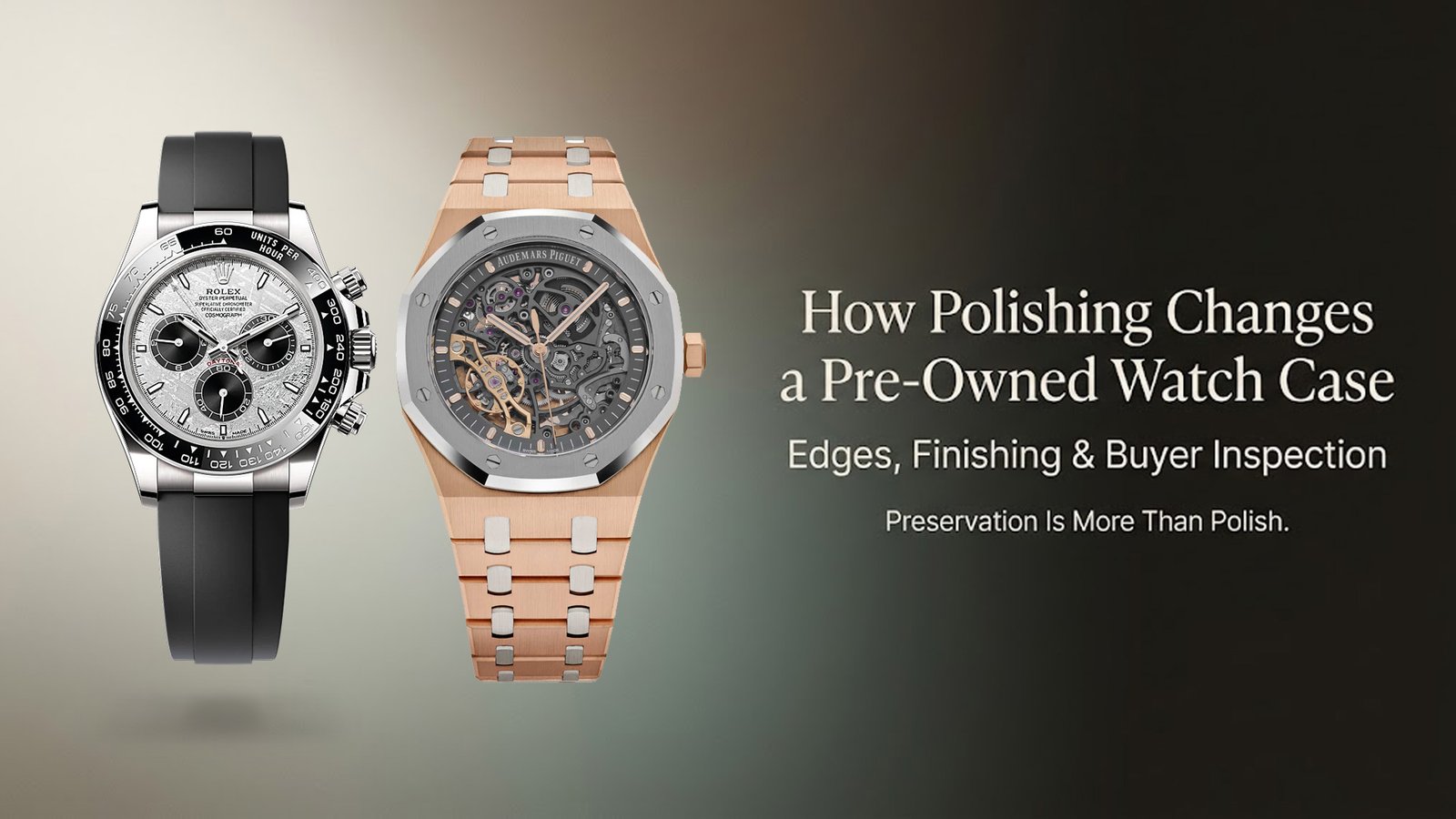
A Scratch-Free Luxury Watch Can Hide an Expensive Detail: Here’s What to Examine
A pre-owned luxury watch with a spotless case can look more appealing than one with visible signs of everyday wear. However, when evaluating pre-owned watch polishing, the absence of scratches does not always mean the watch is better preserved.
Professional refinishing can restore the appearance of a case and bracelet, but the process may involve removing a small amount of surface material. When performed excessively or without respecting the manufacturer’s original geometry, it can soften case edges, change bevels and disturb the relationship between polished and brushed surfaces.
These differences matter to collectors who value accurate case proportions and original finishing. They also help buyers distinguish normal wear from substantial previous cosmetic work.
For anyone purchasing a pre-owned luxury watch in Dubai, learning how to assess polishing is a practical way to make more informed comparisons between watches of the same reference.
What Happens When a Luxury Watch Is Polished?
Watch-case polishing is a controlled finishing process used to change the appearance of a metal surface. Depending on the method, it can reduce visible scratches, restore shine or recreate a particular surface texture.
Luxury-watch cases often combine several finishing techniques. A single case may include mirror-polished areas, satin-brushed sections and precisely defined edges separating the two.
Restoring these finishes requires different tools, techniques and levels of expertise.
Importantly, polishing should not be confused with routine cleaning. Removing fingerprints or surface dirt with a suitable cloth is not the same as mechanically refinishing the metal.
Polishing vs Satin-Brushing
Polishing generally produces a more reflective surface, while satin-brushing creates a directional texture.
A watch may be designed with polished case sides and brushed upper lug surfaces. The visual transition between them contributes to its character.
If a previously brushed surface becomes unnaturally shiny, or the transition between finishes appears uneven, the watch may have undergone inappropriate refinishing.
That observation is a reason for closer examination, not proof of a particular repair history.
- Case Edges: Why Sharp Geometry Matters
The edges of a watch case can reveal information that broad front-facing photographs fail to show.
Many luxury sports watches use deliberate case shapes with carefully controlled transitions. On some designs, those edges are prominent and visually important.
When the case is polished repeatedly, material removal can soften the original lines.
The result may be a watch that looks bright and clean but no longer has the precise profile intended by its manufacturer.
What Does an Overpolished Watch Look Like?
Possible signs of overpolishing a luxury watch include:
- Case edges that appear unusually rounded compared with correct reference images.
- Bevels that look narrow, uneven or inconsistent between matching surfaces.
- Differences in the shape of corresponding lugs.
- Softened transitions between polished and satin-brushed areas.
- Distorted edges around screw recesses or other detailed case features.
- An overall case shape that appears inconsistent with the reference’s original design.
These signs must be interpreted carefully. Some variations can result from photography, manufacturing changes, ordinary wear or the viewing angle.
The most reliable assessment involves examining the actual watch and comparing it with accurate documentation for the same reference and production period.
- Lug Shape: One of the Most Useful Inspection Areas
The lugs connect the watch case to its bracelet or strap. Their proportions help determine the appearance and wearing comfort of the entire watch.
On some luxury watches, the lugs incorporate distinct bevels, polished sides or satin-brushed upper surfaces.
When inspecting a pre-owned watch, compare the two sides of the case rather than looking at only one lug.
Ask whether their shapes appear consistent and whether the edges follow the reference’s intended design.
Why Symmetry Matters
Uneven refinishing can cause visually noticeable differences between opposing lugs.
One lug may appear more rounded than another, or a polished edge may look broader on one side of the watch.
Not every difference indicates significant damage. Some case constructions are intentionally asymmetrical, and photographs can exaggerate perspective.
For that reason, use the correct manufacturer reference as the comparison point.
A generic assumption that every luxury-watch case should be perfectly symmetrical can lead to an incorrect assessment.
- Rolex Case Polishing: What Buyers Should Understand
Rolex sports watches offer a useful example of why finishing matters.
Depending on the reference, a Rolex case and bracelet can combine satin-brushed and polished surfaces. These finishes are intentional design features rather than interchangeable cosmetic treatments.
Rolex’s own servicing information explains that cases and metal bracelets may be professionally refinished as part of its official service procedure.
That means a polished Rolex is not automatically a poorly maintained watch.
The more important questions are whether the work was carried out appropriately, whether the original geometry was respected and whether the buyer understands the watch’s condition.
Polished vs Unpolished Rolex: Which Is Better?
There is no universal answer.
An unpolished watch may retain its original case geometry while showing normal scratches and wear.
A professionally refinished example may look cleaner, with its original surface finishes carefully restored.
Conversely, an aggressively polished case may have lost details that cannot be recreated simply by polishing it again.
Buyers who place particular importance on originality may prefer an example with well-preserved geometry and honest surface wear.
Those who prioritize a clean appearance may consider a professionally refinished example, provided the quality of the work is satisfactory.
The phrase “never polished” should be treated as a statement requiring evidence rather than an automatic guarantee of higher value.
For broader component questions, read the Rolex service parts and originality guide.
- Audemars Piguet Royal Oak: Why Finishing Can Be Especially Noticeable
The Audemars Piguet Royal Oak family is particularly recognizable for its geometric case design and contrasting surface finishes.
Its octagonal bezel, visible screws and precisely defined edges make the quality of refinishing relatively easy to notice when the watch is examined closely.
Audemars Piguet’s service documentation emphasizes preserving the original design when polishing cases and bracelets.
The manufacturer also cautions against excessive aesthetic refinishing over a watch’s lifetime.
That guidance reflects an important principle: cosmetic improvement should not come at the expense of the case’s defining geometry.
How to Inspect a Royal Oak or Royal Oak Offshore
Examine the bezel edges, case sides, lug transitions and bracelet finishing.
Look for uneven brushing, softened bevels or differences between adjoining surfaces.
Check whether the visible screws and surrounding recesses appear damaged or inconsistently finished.
The correct appearance can vary across Royal Oak and Royal Oak Offshore references, so compare the exact model rather than assuming that every version should have identical proportions.
You can explore the Audemars Piguet collection in Dubai and compare relevant reference photographs before requesting more detailed information about a particular watch.
- How Polishing Can Affect Pre-Owned Watch Value
The relationship between watch polishing and resale value depends on the watch, its age, the quality of the work and the preferences of potential buyers.
For a modern everyday luxury watch, careful professional refinishing may be acceptable to many purchasers.
For an older or historically significant reference, preserving original case geometry and surface details may carry greater importance.
However, it would be misleading to assign a universal percentage reduction to a polished watch.
The market does not apply one fixed rule across Rolex, Audemars Piguet, Patek Philippe, Cartier and independent watchmakers.
Condition Should Be Evaluated as a Whole
A watch with an apparently untouched case can still have mechanical issues, missing components or questionable documentation.
Likewise, a professionally refinished watch may have a clear service history and excellent mechanical condition.
A sound buying decision considers case preservation alongside the following:
- Original dial, hands and other visible components.
- Documented maintenance and repairs.
- Bracelet or strap condition.
- Clasp and crown operation.
- Movement performance and any outstanding service needs.
- Original documentation and ownership history.
See the luxury-watch condition grading guide for a broader evaluation framework.
- How to Inspect Watch Polishing Before Buying Online
Online listings often use carefully controlled lighting, which can make it difficult to assess metal surfaces.
One attractive front-facing photograph is not enough to evaluate case geometry.
Request several detailed photographs of the actual watch.
Recommended Inspection Angles
- Front view: Examine the bezel, lugs and general case proportions.
- Left side: Look at the case thickness, surface finishing and lug profiles.
- Right side: Check the crown area and the surrounding geometry.
- Three-quarter view: Assess transitions between polished and brushed surfaces.
- Caseback view: Inspect the caseback edges and signs of previous work.
- Bracelet close-ups: Examine link finishing, clasp condition and wear patterns.
Where possible, request images under diffused lighting as well as direct light.
Highly reflective surfaces can conceal scratches in one photograph while exaggerating them in another. Multiple viewing angles provide a more balanced impression.
For a substantial purchase, photographs should support rather than replace an appropriate physical inspection.
- Questions to Ask Before Purchasing a Polished Watch
Useful questions include:
- Has the case or bracelet been professionally refinished?
- Is the seller aware of any previous polishing?
- Are service records available that describe cosmetic work?
- Have any case or bracelet components been replaced?
- Are there areas where the original edges or surface textures have changed?
- Can the actual watch be examined before completing the transaction?
Remember that a seller may not know every detail of a watch’s earlier ownership history.
A more credible description distinguishes documented facts from information that cannot be confirmed.
Uncertainty should be disclosed, not converted into an unsupported guarantee.
- Should You Polish a Luxury Watch Before Selling It?
If you intend to sell a Rolex, Royal Oak or another high-end watch, resist the assumption that removing every visible scratch will automatically result in a stronger offer.
Some buyers prefer original finishes and may value a watch that has not been cosmetically altered.
Others may appreciate appropriate professional refinishing, depending on the reference and overall condition.
Before authorizing polishing, establish whether the work is genuinely necessary and whether it may change details that collectors value.
It can be sensible to obtain an assessment of the watch in its current condition before deciding to proceed with cosmetic work.
If your objective is resale, the Sell or Trade Watches page provides a route to submit watch details for an enquiry.
Frequently Asked Questions
Does polishing damage a luxury watch?
Appropriate professional refinishing is not inherently damaging, but excessive or poorly performed polishing can remove material and alter the original case geometry.
How can I tell whether a Rolex has been overpolished?
Possible indicators include softened case edges, uneven lug profiles and altered surface transitions. These observations require comparison with the correct reference and cannot always be established conclusively through photographs.
Is an unpolished watch always more valuable?
No. Value depends on the exact reference, overall condition, service history, originality, market demand and the preferences of potential buyers.
Can a polished Royal Oak be restored to its original shape?
Professional refinishing may improve the appearance of a watch, but polishing alone cannot necessarily replace material already removed. The feasibility of corrective work depends on the condition and design of the individual case.
Does a manufacturer service always include polishing?
Service procedures differ by manufacturer and service type. Buyers should review the available documentation rather than assuming every completed service included cosmetic refinishing.
Should I polish my watch before selling it in Dubai?
Not automatically. Consider obtaining an assessment of the watch in its existing condition before authorizing refinishing, especially for a reference where original case geometry may matter to collectors.
Conclusion: A Well-Preserved Case Is About More Than Shine
Understanding pre-owned watch polishing helps buyers recognize why two apparently similar luxury watches can differ in physical preservation.
Minor scratches do not necessarily make a watch undesirable, and professional polishing is not inherently a warning sign. The essential questions concern the quality of the work, the preservation of original geometry and the honesty of the condition description.
Carefully inspect case edges, lugs, bevels and surface finishes alongside the watch’s mechanical and documentary history.
Compare with confidence: Explore the luxury watch collection at Buy & Sell Watches or arrange an appointment to discuss the condition of a particular pre-owned watch.
Meta Title:
Meta Description: Recommended Slug:
Focus Keyword:
Alt Slugs:
- how-polishing-affects-luxury-watch-value
- overpolished-luxury-watch-case-guide
- luxury-watch-polishing-dubai