 +971 58 515 9269

Rolex Service Parts vs Original Parts: What Pre-Owned Buyers in Dubai Should Know

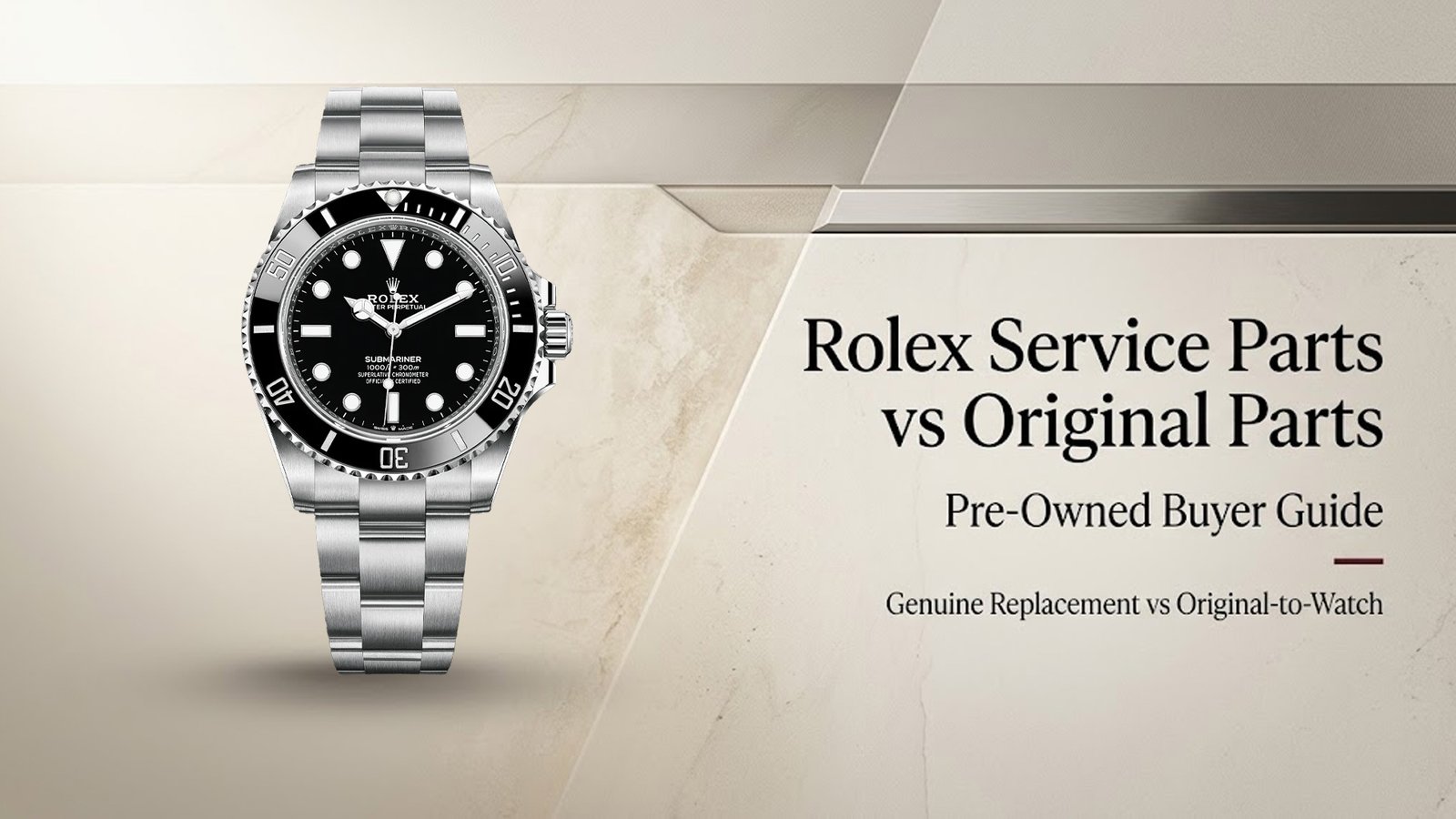
A genuine Rolex replacement component and the component originally fitted when a watch left production are not always the same thing. That distinction becomes important when buying an older, discontinued or collector-focused Rolex in Dubai. A service dial, replacement hands, bezel, crown or movement component may be completely genuine Rolex and mechanically appropriate, yet still change how originality-conscious buyers assess the watch.
Rolex service parts can be genuine manufacturer components while not being original to the watch from the time it was first sold. For modern daily-wear Rolex watches this may be perfectly acceptable, but on vintage and collectible references, replacement dials, hands, bezels and other visible components can materially affect originality, collector demand and resale comparisons.
Three Different Terms Buyers Should Not Confuse
The secondary market often uses “original” too loosely. A more useful approach separates three categories.
| Component Type | What It Means | Buyer Implication |
| Original-to-watch component | The component has remained with the watch from its original production or sale configuration | Often important to collectors, especially on vintage and discontinued references |
| Genuine Rolex service component | A genuine Rolex part fitted during later servicing or repair | Authentic but not necessarily original to the watch |
| Aftermarket component | A non-Rolex component made or fitted outside the original factory specification | Can materially affect authentication, service options and resale demand |
This distinction prevents a common mistake: treating “genuine Rolex” and “original to this watch” as interchangeable descriptions.
Rolex Official Service Can Involve Replacement Parts
Rolex’s current servicing procedure explicitly states that the movement is fully dismantled and parts that no longer meet Rolex requirements are replaced.
Rolex also states that components are examined during service and replacements are made using genuine Rolex parts where required.
This is entirely logical from a manufacturer perspective. The objective of servicing is to return the watch to proper technical and aesthetic functioning.
But a collector may ask a different question:
Is every visible component still the one that was fitted to the watch during its original production period?
Those two questions should not be confused.
For broader maintenance information, see the Rolex maintenance and servicing guide.
Why Service Parts Are Not Automatically Bad
A replacement component can solve a genuine functional problem.
Examples might include a component that is:
- damaged;
- corroded;
- no longer legible;
- mechanically worn;
- unable to meet performance standards;
- unsafe for continued operation.
For somebody buying a relatively modern Rolex as a daily watch, a documented manufacturer service with genuine replacement parts may provide reassurance rather than concern.
The question becomes more nuanced as age, rarity and collector interest increase.
Buyer insight: “Service replacement” is not the same as “fake”. The meaningful questions are whether the part is genuine, whether it is correct for the watch, when it was fitted and how much originality matters for that specific reference.
When Originality Becomes More Important
Originality tends to become more commercially sensitive when dealing with:
- vintage Rolex;
- discontinued sports references;
- unusual dial variants;
- historically significant configurations;
- rare bezel inserts;
- early-production details;
- watches valued partly for ageing and patina.
For these watches, replacing a degraded component may improve functionality but reduce the amount of period-original material remaining.
That trade-off needs to be understood rather than described as universally good or bad.
Service Dials Can Change a Collector’s Assessment
The dial is often one of the most commercially sensitive components on a collectible Rolex.
A service dial may be:
- genuine Rolex;
- correctly installed;
- cleaner than the old dial;
- more legible;
- more functional in low light.
Yet it may differ from the dial originally supplied with the watch.
Differences can involve:
- printing;
- luminous material;
- logo details;
- minute track;
- text arrangement;
- colour;
- period-specific typography.
A vintage collector may therefore prefer an aged but original dial to a cosmetically perfect later service replacement.
Replacement Hands Need the Same Context
Hands can deteriorate, corrode or lose luminous material. Replacement may be appropriate during servicing.
For collector-focused references, however, buyers often look at whether the hands:
- match the dial period;
- have similar luminous ageing;
- are original to the watch;
- were replaced during a known service.
A watch with an aged dial and bright modern service hands can be completely genuine while presenting a different originality profile from an untouched example.
Bezels and Inserts Can Have Major Collector Importance
On watches such as older Submariners and GMT-Master references, bezel inserts can change significantly across production periods.
An original faded insert may have collector appeal precisely because it shows age. A new service replacement may restore colour and functionality but change the visual and historical character of the watch.
When buying:
- identify the bezel type;
- check whether the insert is period-correct;
- ask whether it has been replaced;
- avoid assuming that faded automatically means more valuable;
- avoid assuming that new automatically means better.
Condition and originality need to be considered together.
Crowns and Crystals Often Raise a Different Question
Some components are replaced primarily because they help maintain usability or water resistance.
A crown, tube, gasket or crystal may therefore be changed during the normal life of a watch.
Collector sensitivity varies by:
- reference;
- age;
- rarity;
- how visible or reference-specific the component is;
- whether the original part survives;
- what the buyer expects from the watch.
A vintage watch being purchased as a historical object may be judged differently from a modern Submariner intended for frequent swimming and travel.
Movement Parts Are Usually a Different Conversation
Mechanical wear is expected over decades of operation.
Rolex’s official service process examines movement components individually and replaces those that no longer meet its requirements.
For most buyers, replacing worn internal components with appropriate genuine parts is part of responsible mechanical maintenance.
However, with historically important vintage watches, specialist collectors may still want to understand the extent of movement replacement and previous repair work.
The watch service-history guide can help structure those questions.
Official Service Can Also Include Refinishing
Rolex currently describes case and bracelet refinishing as part of its complete servicing procedure, restoring polished and satin-finished surfaces according to their intended finish.
This is relevant because servicing and polishing are separate originality considerations.
A watch may have:
- genuine original case;
- genuine Rolex service parts;
- officially refinished surfaces.
All three statements can be true simultaneously.
For a modern ownership-focused watch, that may be entirely acceptable. For a vintage collector seeking maximum preservation of original case geometry, the refinishing history may influence desirability.
Why “All Original” Needs Evidence
A seller describing a 20- or 30-year-old Rolex as “all original” should ideally be able to explain what that means.
Useful follow-up questions include:
- Has the watch ever been serviced?
- Was the dial replaced?
- Were the hands replaced?
- Was the bezel or insert changed?
- Is the crown original?
- Was the crystal replaced?
- Has the bracelet been replaced?
- Were movement components changed?
- Was the watch polished?
If the history is unknown, it is better to say so than to convert uncertainty into a confident originality claim.
Can Service Documents Prove Which Parts Were Replaced?
Sometimes service paperwork provides useful details about work carried out, but the level of information varies.
Documents can help establish:
- service date;
- service provider;
- work authorised;
- certain replacement components;
- refinishing;
- service warranty.
Where records are incomplete, physical inspection becomes even more important.
Documentation should be considered using the luxury watch documentation guide.
Service Parts Versus Aftermarket Parts
This is the most important distinction.
A genuine Rolex service dial and an aftermarket dial are not equivalent.
A genuine service part:
- comes from Rolex’s parts ecosystem;
- may be installed during legitimate service;
- can be correct and functional;
- is still genuine Rolex.
An aftermarket part is produced outside the manufacturer and can alter:
- authentication;
- appearance;
- service eligibility;
- collector demand;
- resale value.
Do not allow the broad phrase “replacement part” to hide this distinction.
What About Aftermarket Diamonds?
Aftermarket gem-setting is a modification rather than ordinary service replacement.
A Rolex altered with non-factory diamonds may contain a genuine Rolex movement, case and bracelet while still no longer corresponding with its original factory configuration.
This can change:
- future manufacturer servicing;
- buyer pool;
- collector desirability;
- valuation methodology;
- authentication complexity.
Factory-set and aftermarket-set watches should therefore be compared separately.
How Service Parts Affect Price
There is no universal percentage deduction.
The effect depends on:
- reference;
- age;
- rarity;
- component replaced;
- quality and correctness of the service part;
- original part availability;
- collector demand;
- overall condition.
A service crown on one watch may have little practical market effect, while a replacement dial on a highly collectible vintage reference can be much more significant.
This is why buyers researching Rolex watch prices in Dubai should compare originality alongside reference and condition.
Collector insight: The most expensive-looking example is not automatically the most original. A heavily restored watch can appear cleaner than a preserved example while containing more replacement components.
How Condition and Originality Should Be Separated
A watch can be:
- excellent cosmetically but low in originality;
- well worn but highly original;
- mechanically excellent with genuine service parts;
- visually attractive but aftermarket modified.
That is why condition grading and originality assessment should never be collapsed into one adjective.
Use the watch condition guide alongside the authentication guide when evaluating a pre-owned Rolex.
Which Buyer Should Prefer Maximum Originality?
Maximum originality tends to matter most to buyers focused on:
- vintage collecting;
- rare references;
- period-correct details;
- historical preservation;
- long-term collector desirability.
Which Buyer May Prefer a Recently Serviced Watch?
A documented serviced example may make more sense for somebody focused on:
- frequent wear;
- reliability;
- water resistance;
- mechanical performance;
- reduced immediate maintenance uncertainty.
Neither buyer is necessarily making the wrong decision. They are buying for different purposes.
Questions to Ask Before Buying a Serviced Rolex
- When was the last service?
- Who performed it?
- Which parts were replaced?
- Is the dial original to the watch?
- Are the hands original?
- Has the bezel or insert changed?
- Was the crown replaced?
- Was the watch polished?
- Are original removed components included?
- Is service documentation available?
- Are any aftermarket parts fitted?
Frequently Asked Questions
Are Rolex service parts genuine?
Genuine Rolex service components fitted through legitimate Rolex servicing are genuine manufacturer parts. They may still be later replacements rather than the components originally fitted when the watch was produced.
Does a service dial make a Rolex fake?
No. A genuine Rolex service dial can be authentic while not being original to the watch. The distinction can still matter to collectors.
Are original Rolex parts always more valuable?
Not in every situation. Collector-focused vintage watches often benefit from originality, but mechanical functionality and component condition also matter. The impact is reference-specific.
Should I avoid a Rolex with replacement hands?
Not automatically. Determine whether they are genuine Rolex service hands, aftermarket parts or incorrect components, and consider how originality matters for that reference.
Does Rolex replace movement parts during service?
Rolex’s official servicing procedure states that movement components are examined and parts that no longer meet its requirements are replaced.
Does Rolex polish watches during official servicing?
Rolex describes refinishing the case and metal bracelet according to their original polished and satin-finished surfaces as part of its complete servicing procedure.
Are aftermarket diamonds the same as service parts?
No. Aftermarket gem-setting is a modification to the watch rather than ordinary manufacturer service replacement and should be disclosed separately.
Where can I compare pre-owned Rolex watches in Dubai?
Browse the Rolex collection at Buy & Sell Watches and compare each watch by reference, condition, originality, service history and set completeness.
Buy the Rolex That Matches Your Ownership Goal
A recently serviced Rolex and a highly original collector example can both be strong watches, but they answer different priorities. Before buying in Dubai, decide whether your main concern is mechanical reliability, historical originality, daily wear, collectability or a balance of those factors.
Then evaluate the specific watch accordingly instead of treating every genuine replacement component as either automatically desirable or automatically damaging.