 +971 58 515 9269

Vintage Watch Dial Originality: How to Assess Refinished Dials, Lume, Hands & Service Parts

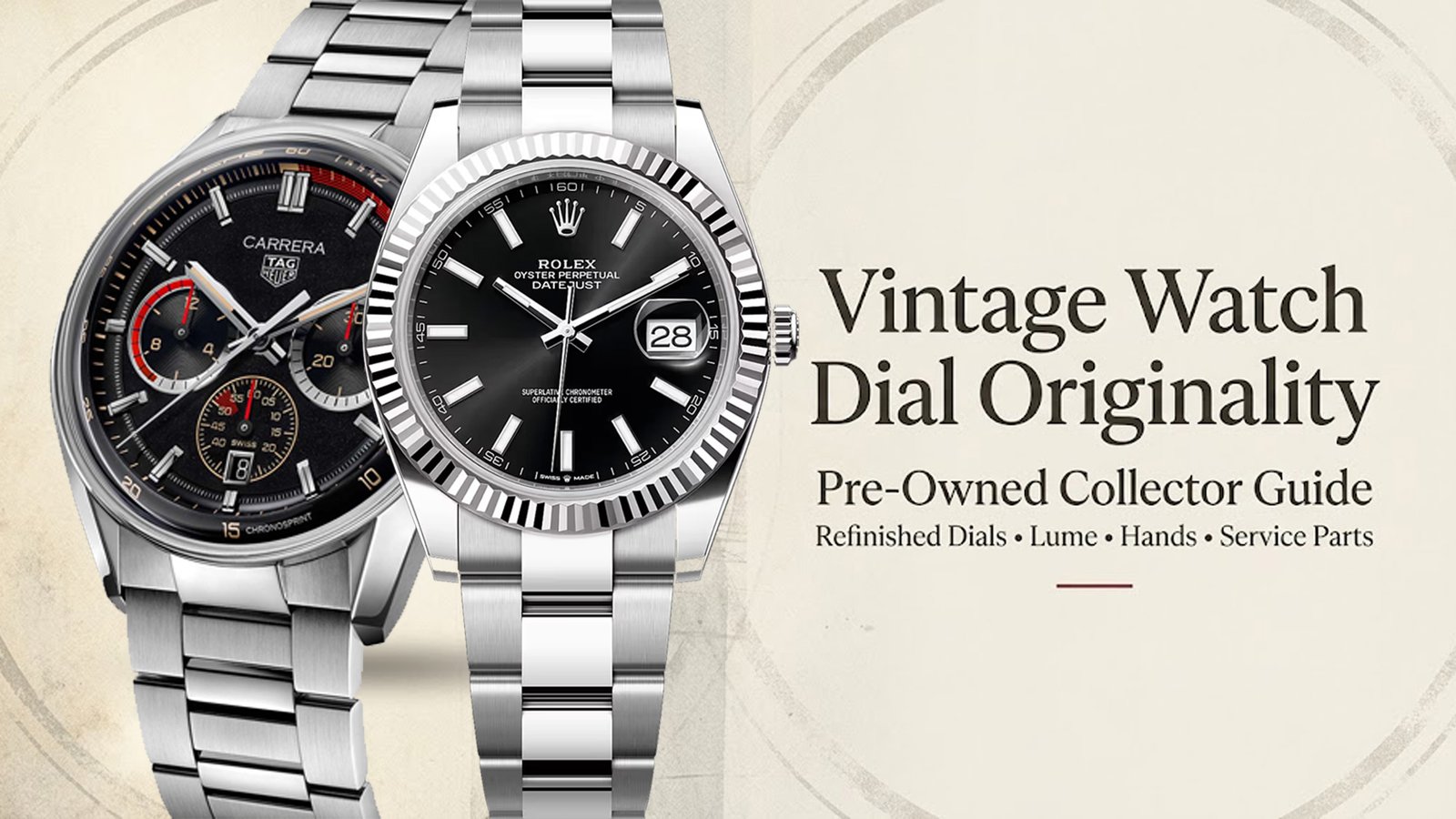
A vintage watch can look beautifully preserved and still be a very different watch from the one that originally left the manufacturer. Dials may have been refinished decades ago, hands replaced during routine servicing, luminous material renewed, bezels exchanged and cases polished more than once. None of these details automatically makes a watch undesirable, but they can completely change how an experienced collector assesses originality, historical interest and value.
When assessing a vintage watch, examine the dial, printing, luminous material, hands, bezel, crown, case geometry, movement and service history together. A replaced service component is not automatically a problem, and natural patina is not automatically desirable; the important question is whether the watch is correctly described and whether its present configuration makes sense for the reference and period.
Vintage Buying Is Really a Study of What Happened to the Watch
Age alone does not make a watch collectible. Two watches made in the same year can have very different appeal because one may retain most of its original visible components while the other has been heavily restored.
That is why experienced buyers tend to ask a different set of questions from someone shopping for a modern pre-owned watch.
They want to know:
- Is the dial believed to be original?
- Has the dial been cleaned, touched up or completely refinished?
- Are the hands correct for the reference and period?
- Does the luminous material appear original, renewed or replaced?
- Is the bezel or bezel insert period-correct?
- Has the crown been replaced during service?
- Has repeated polishing changed the case geometry?
- Does the bracelet correspond with the watch?
- Are there service records explaining later components?
A broad guide to buying vintage watches in Dubai can help identify the overall purchase process. Once a particular watch is under consideration, however, originality requires a much closer examination.
Original, Correct and Period-Correct Do Not Always Mean the Same Thing
Collectors often use these words casually, but they describe different ideas.
| Term | What It Usually Means | Why the Distinction Matters |
| Original to the watch | The component is believed to have been fitted when the individual watch was first sold | This is generally the strongest form of originality |
| Correct for the reference | The component is consistent with that reference, but may have been fitted later | A service replacement can be correct without being original to that particular watch |
| Period-correct | The component belongs to the right general production period | Useful for understanding restored watches, but does not prove factory originality |
| Service replacement | A component fitted during maintenance | May improve function while changing collector originality |
| Aftermarket | A component not produced or supplied as the manufacturer’s intended component for the watch | Requires clear disclosure and may affect future buyer demand |
| Refinished | An original or replacement component has been cosmetically restored or repainted | Can materially change how collectors assess the watch |
This language matters because a seller can truthfully say that a hand set is “correct” while the buyer may incorrectly assume it is original to the watch.
Collector insight: The most useful vintage descriptions separate originality from correctness. “Correct service replacement” tells a buyer far more than simply saying that everything looks right.
The Dial Usually Deserves the Most Time
The dial is often the first area experienced collectors study because it carries so much of a vintage watch’s identity.
A refinished dial may still be attractive. In earlier decades, refinishing was often considered sensible maintenance. Owners wanted watches to look clean and legible; they were not necessarily thinking about how collectors might evaluate originality fifty years later.
That history is important because restoration should not automatically be interpreted as deception.
The real issue is disclosure.
When examining a dial, consider:
- the shape and spacing of printed text;
- the relationship between minute tracks and hour markers;
- the appearance of logos and signatures;
- surface texture;
- colour consistency;
- signs of cleaning around applied markers;
- luminous plots and how they have aged;
- whether ageing appears natural across the dial.
Do not attempt to authenticate a valuable vintage dial solely from internet photographs. Small printing, surface and construction differences can require specialised reference knowledge and physical examination.
Patina Can Be Attractive, Neutral or Damaging
The word “patina” is frequently used as though any sign of age creates value. It does not.
Natural ageing can be attractive when it is coherent with the watch. A gently faded dial, aged luminous material or a bezel insert that has changed colour naturally may appeal strongly to collectors.
Other changes may indicate moisture, corrosion, heat exposure, poorly executed restoration or chemical damage.
Consider the pattern rather than the simple presence of ageing.
Uniform colour change can tell a different story from concentrated staining around the edge of a dial. Matching ageing between hour plots and hands can be reassuring, while dramatically different colours may justify further investigation. Even then, visual matching alone cannot establish originality.
Buyer insight: Never pay a premium simply because a seller calls a dial “tropical”, “creamy”, “ghost” or “beautifully patinated”. First establish what caused the appearance and whether knowledgeable collectors recognise that form of ageing as desirable for the particular reference.
Re-Lumed Dials and Hands Need Context
Luminous material was originally applied to help a watch remain readable in low light. Over time it can age, discolour, crack or lose its luminous performance.
Historically, replacing or renewing lume could be considered ordinary maintenance. Today, on a collectible vintage watch, that same intervention may affect originality.
Useful questions include:
- Are the dial plots believed to retain their original luminous material?
- Have the hands been re-lumed?
- Were the hands themselves replaced?
- Do the materials and colours correspond sensibly with the watch’s age?
- Is there documentary evidence from previous service?
Do not use lume colour as a simple authenticity test. Age, storage conditions, humidity and previous intervention can all change appearance.
Replacement Hands Can Be Legitimate Without Being Collector-Original
Hands are functional components. They can corrode, lose luminous material, become damaged during servicing or be replaced because a manufacturer considered the originals unsuitable for continued use.
For a daily-wear vintage watch, correctly replaced hands may be entirely acceptable.
For a highly collectible reference, original hands may be a significant part of the watch’s appeal.
The buyer therefore needs to determine their own priority.
If historical originality matters more than cosmetic freshness, a watch with naturally aged original hands may be preferable. If dependable regular wear matters more, properly fitted service hands may be easier to live with.
Neither preference is inherently wrong.
Service Parts Are Not the Same as Aftermarket Parts
This distinction is particularly important.
A manufacturer or qualified service facility may legitimately replace worn components with later service parts. A crown, crystal, bezel insert, handset or movement component can therefore be genuine manufacturer equipment but not original to the individual watch.
An aftermarket part is a different matter. It comes from outside the original manufacturer supply chain and can alter both collectability and how the watch should be represented.
Before buying, ask the seller to distinguish clearly between:
- original components;
- manufacturer service replacements;
- period-correct replacements;
- aftermarket components;
- unknown components that have not been conclusively identified.
The site’s guide to luxury watch authentication in Dubai is useful here because authentication and originality are related but separate questions.
Polishing Can Change More Than Surface Scratches
Many vintage watches were polished routinely during service. At the time, owners generally regarded a freshly polished case as a benefit.
Collectors today often assess the result differently.
Repeated polishing can soften edges, reduce lug thickness, change bevels, weaken engraved details and alter the relationship between brushed and polished surfaces.
That does not mean every polished watch should be avoided. The degree and quality of the work matter.
Compare the case against known correct examples of the same reference. Look at:
- lug thickness and symmetry;
- bevels or chamfers where applicable;
- case-back edges;
- engraving depth;
- brushed and polished transitions;
- overall geometry.
The existing watch condition grading guide provides a broader framework for separating surface condition from structural condition.
Bracelets, End Links and Buckles Can Matter More Than Expected
On some vintage references, the correct bracelet can be an important part of the complete watch.
Inspect:
- bracelet reference or identifying marks where applicable;
- end-link correctness;
- clasp type;
- date codes where relevant and understood;
- stretch and wear;
- repair work;
- number of links;
- whether replacement sections have been fitted.
A later genuine bracelet may make a watch more wearable while reducing its period originality. Again, the best answer depends on what the buyer wants.
Service History Can Explain an Apparently Mismatched Watch
Suppose a vintage watch has a later crown, newer hands and a replacement crystal. Without context, a buyer may assume that somebody assembled the watch from unrelated parts.
A documented manufacturer service from decades earlier may provide a very different explanation.
This is why the service history of a pre-owned watch should be reviewed alongside the physical watch rather than afterwards.
Useful documentation includes:
- manufacturer service invoices;
- watchmaker invoices;
- dealer records;
- historic photographs;
- auction descriptions;
- previous valuation documents;
- correspondence explaining restoration work.
Box and Papers Are Helpful but Often Less Complete on Older Watches
It is entirely normal for older watches to have lost packaging or paperwork over decades of ownership.
The absence of original papers should therefore not automatically disqualify a vintage watch.
Instead, look at the wider provenance file. A watch without its original certificate may still have decades of service documentation, family ownership records or recognised auction history.
Conversely, an old box and certificate should not stop you examining whether the dial, hands and case remain correct.
The luxury watch provenance guide and watch documentation guide explain how different forms of evidence contribute to the ownership story.
How to Compare Two Vintage Examples of the Same Reference
Do not reduce the decision to “better condition versus worse condition”.
A freshly restored example may look visually cleaner. Another may show more scratches but retain its original dial, hands and sharper case.
Ask which qualities you value more.
| Example A | Example B |
| Refinished dial | Original dial with visible ageing |
| Bright replacement hands | Period hands with matching ageing |
| Highly polished case | More surface wear but stronger geometry |
| Later service bracelet | Older correct bracelet with wear |
| Visually fresher | Historically more coherent |
Neither description alone establishes which watch should cost more. Rarity, reference, provenance, mechanical health and buyer demand all influence the outcome.
Resale insight: Vintage liquidity often depends on how easily the next knowledgeable buyer can understand the watch. Clear disclosure of restoration and service components can make an imperfect but honest watch easier to sell than a cosmetically attractive watch with unanswered questions.
Frequently Asked Questions
Is a refinished dial always bad?
No. Some collectors avoid refinished dials, while others accept them when the restoration is disclosed and the purchase price reflects it. The important point is understanding what you are buying.
Does matching lume prove the hands and dial are original?
No. Matching appearance can be encouraging, but hands and dials can be restored or re-lumed to match. Authentication should combine reference knowledge, component examination and provenance.
Are service replacement parts genuine?
They can be genuine manufacturer parts while still being later replacements rather than original components fitted when the watch was first sold.
Is an unpolished vintage watch always more valuable?
No. Overall condition, rarity, originality and buyer demand still matter. Claims that a watch is unpolished should also be assessed critically rather than accepted without examination.
Can a vintage watch without papers still be collectible?
Yes. Many important older watches no longer have their original papers. Provenance can also be supported by service records, historic invoices, auction history and other credible documentation.
Should I replace a damaged vintage crystal?
That depends on the reference and whether the original crystal has collector significance. A damaged crystal can affect wearability, but some signed or unusual original crystals are themselves desirable components.
Should I buy the cleanest-looking vintage watch?
Not automatically. A highly polished or heavily restored watch may look cleaner than an example retaining more of its original surfaces and components.
Discuss a Vintage Watch Before You Buy
If you are considering an older Rolex, Patek Philippe, Audemars Piguet, Omega or another collectible reference, gather the reference number, movement information, clear photographs, dial and hand details, service history and any available provenance before making a decision. You can review luxury watches available in Dubai or discuss the individual watch with Buy & Sell Watches when a more detailed pre-owned assessment is required.