 +971 58 515 9269

Pre-Owned Cartier Panthère Buying Guide: Size, Bracelet, Quartz Movement & Diamonds

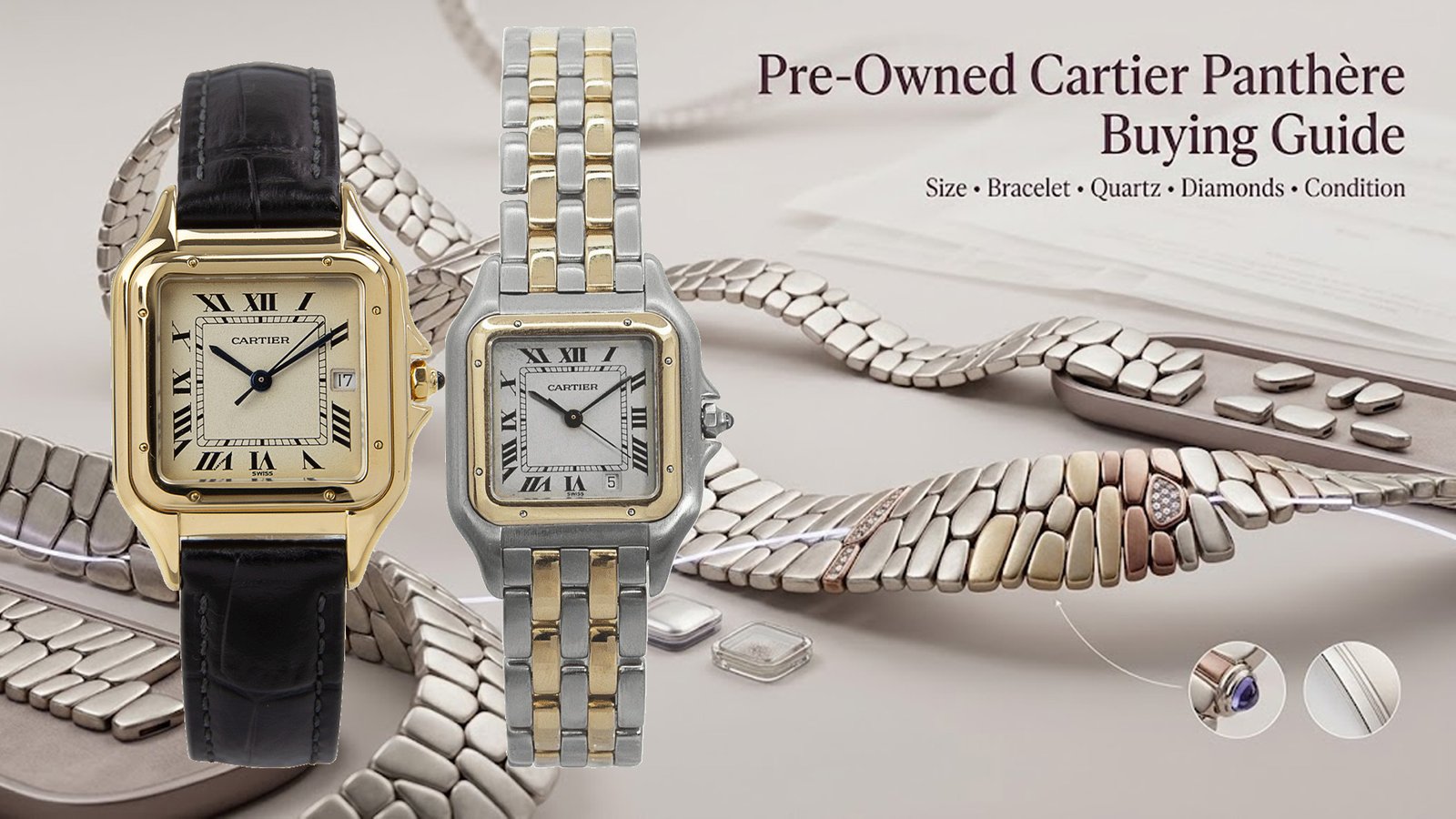
The Cartier Panthère is easy to underestimate as a pre-owned purchase because its design feels more like jewellery than a conventional sports or complication watch. That is precisely why the inspection process needs to be different. Bracelet condition, link count, case geometry, dial correctness, quartz movement health, crown details and whether any diamonds are factory-set can matter more than the mechanical questions buyers usually ask about an automatic watch.
Before buying a pre-owned Cartier Panthère, confirm the complete reference, size, metal, bracelet length, quartz movement operation, dial and crown configuration, and whether any diamonds are factory-set or aftermarket. The bracelet is central to the Panthère’s design, so missing links, heavy polishing and stretched or damaged articulation should be evaluated as carefully as the watch head itself.
The Panthère Is a Watch and Bracelet in Equal Measure
The Panthère has always relied heavily on its supple bracelet architecture.
This makes it different from a watch where the bracelet can be treated as a replaceable accessory.
For many buyers, the reason the Panthère works is the way it moves around the wrist.
The broad Cartier watches in Dubai guide covers the brand. For a Panthère purchase, bracelet condition deserves far more attention.
Start With the Exact Reference and Size
The Panthère is offered in several sizes, materials and jewellery configurations.
| Buying Factor | What to Confirm | Why It Matters |
| Reference | Complete Cartier reference | Establishes correct metal, size, dial and gem-setting |
| Case size | Mini, small, medium or large depending on reference | Panthère proportions change considerably on the wrist |
| Metal | Steel, gold, two-tone or other reference-specific configuration | Affects weight, condition and refinishing |
| Bracelet | Correct links, length and condition | The bracelet is fundamental to fit and design |
| Movement | Correct quartz operation | A stopped watch may simply need maintenance, but it still requires diagnosis |
| Gem-setting | Factory or aftermarket | The two have different secondary-market implications |
Do not describe every Panthère simply as “small”.
A mini precious-metal Panthère and a large yellow-gold Panthère create very different ownership experiences.
Small Panthère: The Classic Jewellery Proportion
Current small steel Panthère examples use compact rectangular proportions and a very slim case.
This format works particularly well for someone who wants:
- a jewellery-first watch;
- something that layers with bracelets;
- traditional Cartier proportions;
- a slim profile;
- quiet daily wear.
The small size can still have considerable visual presence when paired with yellow gold, two-tone metal or diamonds.
Large Panthère: Stronger Wrist Presence
Larger Panthère references change the balance between dial and bracelet.
Instead of reading primarily as a delicate jewellery watch, a larger case creates a more obvious timepiece presence.
This may suit someone who:
- already wears larger watches;
- wants easier dial readability;
- prefers bolder jewellery;
- wants one Cartier for both casual and formal wear.
Size should be chosen based on the wearer, not old assumptions about what women’s watches should look like.
Style insight: A Panthère can appear larger or smaller depending on metal, diamond-setting and bracelet colour. Case dimensions should therefore be considered alongside the complete configuration.
Bracelet Length Should Be Confirmed Before Payment
This is particularly important when buying remotely.
Ask the seller for:
- current bracelet circumference;
- number of removable links where applicable;
- number of spare links included;
- whether any links have been replaced;
- condition of the clasp;
- whether link articulation remains smooth.
A beautiful Panthère that cannot fit the intended wrist without sourcing expensive additional links is not the same purchase as a complete bracelet example.
Check Bracelet Wear Link by Link
The Panthère bracelet is made to articulate closely around the wrist.
Inspect it for:
- stretched or unusually loose articulation;
- bent links;
- deep scratches;
- dents;
- uneven polishing;
- damaged clasp components;
- incorrect replacement links;
- wear between adjoining links.
Do not judge only by how shiny the bracelet appears.
A heavily polished bracelet may look fresh while having lost sharper original definition.
The site’s watch condition grading guide is useful for separating surface appearance from structural wear.
Quartz Should Not Be Treated as a Negative
The Panthère is intentionally offered with quartz movements across many references.
For this type of watch, quartz suits the thin case and jewellery-led design.
A pre-owned buyer should therefore focus on condition and maintenance rather than treating quartz as an inferior technical choice.
Check:
- whether the watch is running;
- whether time-setting operates normally;
- whether there is evidence of battery leakage or neglect;
- whether recent battery replacement is documented;
- whether the case was properly closed and tested afterwards where relevant.
Buyer insight: A stopped quartz Panthère should not automatically be assumed to need only a battery. High-value watches deserve proper diagnosis before the purchase price is agreed.
Battery History Can Be Useful Documentation
A dated service or battery-replacement invoice can answer several practical questions.
It may establish:
- when the case was last opened;
- who performed the work;
- whether seals were replaced;
- whether other maintenance was recommended;
- whether the watch was tested afterwards.
Use the watch service-history guide when comparing documentary evidence.
Factory Diamonds and Aftermarket Diamonds Are Different Purchases
Cartier produces factory diamond-set Panthère watches.
The secondary market also contains genuine Cartier watches that have had diamonds added later.
A buyer should never assume that diamonds are factory-set simply because the quality appears high.
Ask:
- whether the exact reference was originally diamond-set;
- whether the bezel, case or bracelet has been modified;
- whether original components remain available;
- who performed aftermarket work;
- whether metal was permanently altered;
- how the modification affects servicing and resale.
For a broader look at Cartier purchases, see the Cartier watch buying guide.
Inspect the Crown Carefully
The crown is a distinctive part of Cartier’s design vocabulary.
Depending on the reference, the crown detail and stone specification can differ.
Check:
- correct shape;
- secure fit;
- condition;
- stone or cabochon consistency with the reference;
- evidence of replacement;
- damage caused by impact.
A replacement crown may be legitimate service work, but it should be disclosed where known.
The Dial Should Be Judged Against the Exact Reference
Panthère dials can look deceptively simple.
Examine:
- Cartier signature;
- Roman numerals;
- minute track;
- hands;
- dial surface;
- any moisture staining;
- alignment within the case.
Do not use a secret signature or one printed detail as a single authenticity test.
The Cartier authenticity guide should be used as part of a broader physical assessment.
Polishing Needs to Be Judged Differently on Gold
Precious-metal Panthère watches can pick up scratches quickly because polished gold surfaces show contact.
That does not mean every scratch should be removed.
Repeated aggressive polishing can alter case and bracelet definition.
When comparing two watches, ask:
- how much original geometry remains;
- whether edges are still even;
- whether bracelet links remain well defined;
- whether clasp engravings remain clear;
- whether polishing has been disclosed.
Two-Tone Panthère Watches Require Colour and Component Consistency
On steel-and-gold configurations, inspect the whole bracelet for consistency.
Look for:
- incorrect replacement links;
- mismatched metal tone;
- uneven polishing;
- wear concentrated on gold components;
- clasp correctness.
This is particularly relevant on older watches that may have received replacement bracelet sections over time.
Box and Papers Improve Completeness but Do Not Replace the Watch
Cartier presentation materials, warranty documentation, purchase invoices and service records can strengthen a Panthère’s ownership story.
They do not independently prove that the physical watch remains original.
A no-papers Panthère may still be a strong purchase if authenticity, condition and price are properly assessed.
Who Should Choose a Panthère Instead of a Santos or Tank?
The Panthère makes most sense when bracelet character and jewellery presence are central to the decision.
The Santos offers a stronger traditional wristwatch character, while the Tank provides a different rectangular design language.
The existing Cartier Santos vs Tank comparison covers those two families. The Panthère sits elsewhere: it is designed to behave as jewellery and watch simultaneously.
Resale insight: A Panthère with the correct bracelet length, spare links, factory configuration and clear service history can be easier for the next buyer to evaluate than a highly polished example with missing bracelet components.
Frequently Asked Questions
Are Cartier Panthère watches quartz?
Many current Panthère references use quartz movements. Always verify the exact reference rather than assuming every historical version has identical specifications.
Is a small Panthère too small for daily wear?
No. The small size is deliberately jewellery-like and works well for buyers who prefer compact proportions.
Can I add links to a pre-owned Panthère?
Depending on the reference and bracelet, additional links may be available, but buyers should confirm bracelet fit before purchase rather than assume replacement links will be easy or inexpensive to source.
Are aftermarket diamonds acceptable?
They may appeal to some buyers, but they are different from a factory diamond-set Cartier and should be disclosed clearly.
Should I avoid a heavily polished gold Panthère?
Examine how much original case and bracelet definition remains. Cosmetic freshness is not automatically more desirable than honest surface wear.
Do Cartier papers prove authenticity?
No. Papers support provenance and completeness but do not replace physical examination.
Where can I compare Cartier Panthère watches in Dubai?
You can browse current Cartier watches available through Buy & Sell Watches and compare individual Panthère references based on availability.
Discuss a Cartier Panthère
If you are evaluating a pre-owned Panthère, provide the complete reference, metal, dimensions, bracelet length, spare-link count, dial, diamond status, battery or service history and set details. Buy & Sell Watches can then discuss the individual watch on its real condition and configuration.