 +971 58 515 9269

Pre-Owned Franck Muller Vanguard Buying Guide: Reference, Strap, Buckle & Aftermarket Components

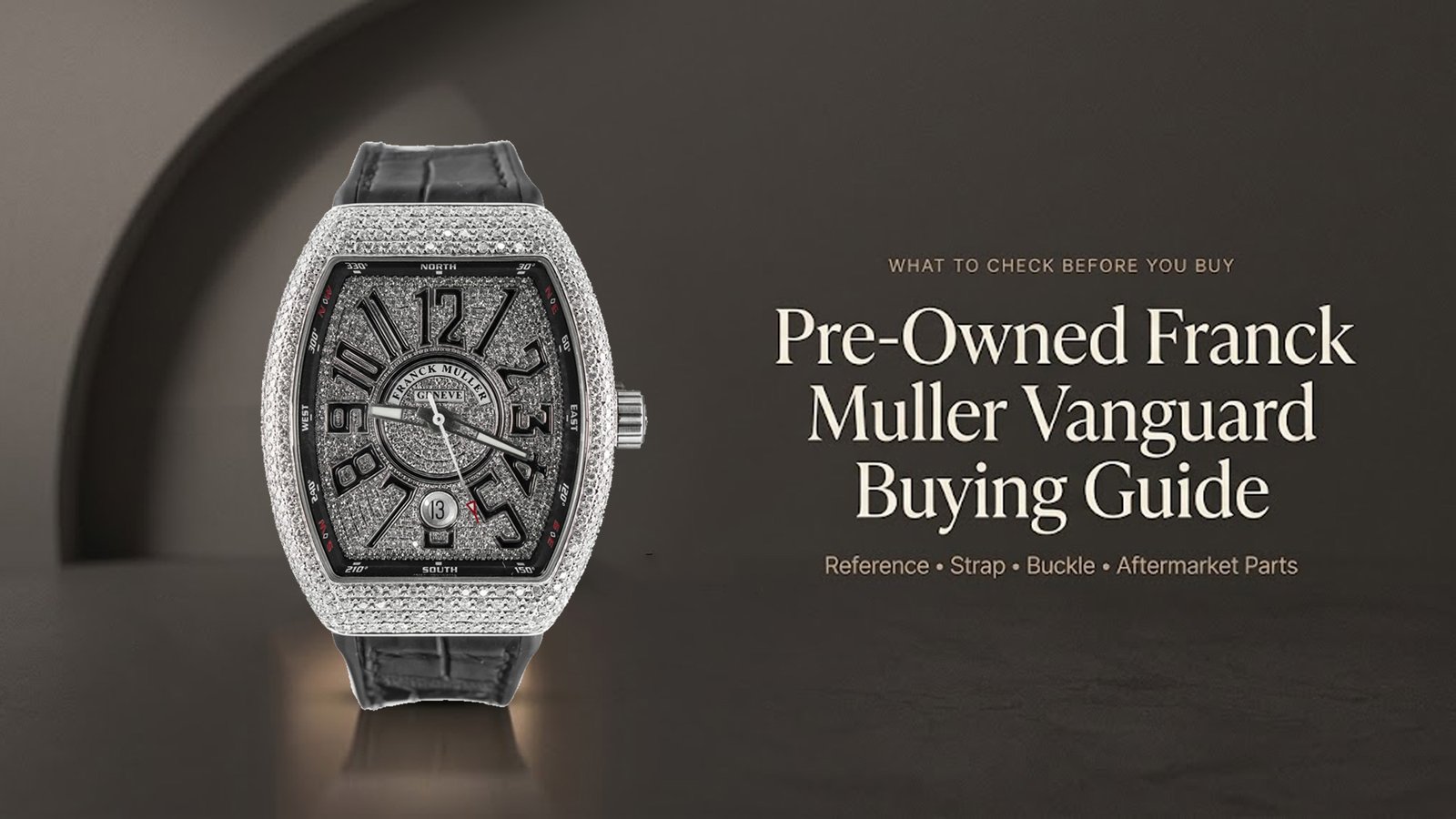
A pre-owned Franck Muller Vanguard can look straightforward until two similar watches are placed side by side. The same broad Vanguard name covers different references, materials, complications, dial executions and strap arrangements, while some secondary-market examples may also contain aftermarket elements. For a buyer, the practical challenge is not simply deciding whether the watch looks attractive. It is establishing exactly which Vanguard is being offered and whether the physical configuration matches the way it has been described.
Before buying a pre-owned Franck Muller Vanguard, confirm the complete reference, case material, movement type, dial, strap and buckle configuration, and ask whether any visible component is aftermarket or has been replaced. The Vanguard’s integrated strap and distinctive curved case make condition and component correctness particularly important when comparing secondary-market examples.
The Vanguard Name Covers More Than One Type of Watch
Franck Muller’s Vanguard family is broad. The manufacturer currently groups several executions within it, including classical models, chronographs, tourbillons, skeleton watches, Yachting versions and other specialised variants.
The separate Vanguard Racing collection also contains classical, chronograph, tourbillon and skeleton versions.
That makes the complete reference important from the first conversation.
A listing that says only “Franck Muller Vanguard” leaves too many unanswered questions.
Start by asking for:
- the complete reference;
- case material;
- movement type;
- dial configuration;
- strap material;
- buckle or clasp specification;
- box and papers;
- service history;
- whether any part of the watch is aftermarket.
The broad Franck Muller watches in Dubai guide is useful for understanding the brand. For an actual Vanguard purchase, reference-level inspection is the more important next step.
Why the Case Shape Changes the Buying Process
The Vanguard is defined by a curved, tonneau-style design rather than the familiar circular profile of many sports watches. Its strap is integrated into the case architecture, extending the curved appearance of the watch.
That means the watch needs to be judged as a complete object on the wrist.
| Area | What to Examine | Why It Matters |
| Case | Edges, curved profile, impact marks, screws and refinishing | The case shape is central to the Vanguard’s design |
| Crystal | Scratches, chips and edge damage | Curved case architecture can make replacement or repair more reference-specific |
| Dial | Correct numerals, colour, date layout and reference consistency | Vanguard references exist in many executions |
| Strap | Material, wear, fitting, originality and sizing | The strap forms part of the integrated case design |
| Buckle | Correct construction, material, condition and operation | An incorrect buckle changes the completeness of the watch |
| Movement | Correct calibre family and proper operation | Different Vanguard variants can use different movements and complications |
| Modifications | Gem-setting, coating, dial work or other aftermarket alterations | Modified watches should not be compared directly with original-standard examples |
Fit Matters More Than the Number in the Reference
The Vanguard’s shape gives it a different wrist presence from a round watch with a similar stated width.
A curved tonneau case can follow the wrist more closely, while the integrated strap influences how securely the watch sits. This is why buyers should resist making fit decisions from dimensions alone.
Try the actual watch where possible.
Look at:
- whether the upper and lower case sit comfortably;
- whether the strap pulls the case into the wrist correctly;
- whether the crown presses against the hand;
- whether the buckle sits centrally under the wrist;
- whether the strap has enough remaining adjustment;
- whether the watch rotates excessively when worn.
Buyer insight: A Vanguard can appear large in photographs yet sit surprisingly securely because of its curvature. The opposite is also possible if the strap length or configuration is wrong for the wearer’s wrist. Fit should be assessed on the complete watch, not the case measurement alone.
The Strap Is Part of the Watch’s Architecture
On many watches, buyers treat a strap as something that can be replaced later without much thought.
The Vanguard deserves more attention because its strap integrates visually into the case.
Inspect the strap for:
- cracking or separation;
- excessive creasing;
- damage around fixing points;
- heavy moisture wear;
- poorly executed replacement fitting;
- incorrect dimensions;
- aftermarket branding or construction being presented as original.
A replacement strap is not inherently a problem. Straps are wear components. The buyer simply needs to know whether the fitted item is original Franck Muller, a correct manufacturer replacement or an aftermarket alternative.
Check the Buckle Separately
A watch can have the correct strap and still be missing the correct buckle.
The buckle should therefore be examined as an independent component.
Look for:
- correct material relative to the reference;
- secure closure;
- significant impact damage;
- over-polishing;
- incorrect engraving or construction;
- obvious mismatch with the strap;
- disclosure if a replacement has been fitted.
If the watch is being presented as a full set or particularly complete example, the original buckle and strap configuration may carry more importance than they would on a purely daily-wear purchase.
Aftermarket Does Not Mean One Specific Thing
This is where buyers need to ask better questions.
A listing marked “aftermarket” can refer to very different interventions. It might involve gem-setting, a dial, a strap, a case treatment or another changed component.
Do not assume.
Ask the seller:
Exactly which component is aftermarket?
That single question is much more useful than debating whether “aftermarket watches are good or bad”.
Some buyers deliberately want customised pieces. Others only want a factory-standard configuration. Both positions are legitimate if the watch is represented clearly.
Where problems arise is when a modified watch is compared with a manufacturer-original example without explaining the difference.
Resale insight: Customisation can narrow the future buyer pool even when the work is visually impressive. Buyers who may want to resell later should understand whether the next buyer is likely to value the modification in the same way.
Aftermarket Gem-Setting Requires Specific Due Diligence
If a Vanguard has diamonds or gemstones that were not fitted by the manufacturer in that configuration, the buyer should inspect more than appearance.
Questions should include:
- Was the case altered to accept the stones?
- Which components were modified?
- Is the original component included?
- Has the case been drilled, cut or otherwise permanently altered?
- Who carried out the work?
- Does the modification affect future servicing options?
- Is the watch being priced as a customised piece rather than a factory-set example?
The presence of diamonds does not automatically increase secondary-market desirability.
Factory gem-setting and aftermarket gem-setting are different commercial propositions and should be described accordingly.
Do Not Generalise Movement Specifications Across the Vanguard Range
The Vanguard family includes time-and-date watches, chronographs, tourbillons and skeletonised executions. Their movement specifications are therefore not interchangeable.
When considering a particular example, verify the full reference first and then determine:
- automatic or manual winding;
- functions;
- date configuration;
- chronograph operation where fitted;
- correct movement designation;
- expected service requirements.
A general statement such as “all Vanguard watches use the same movement” should immediately be treated with caution.
Service History Is Particularly Useful on Complicated Variants
A simple automatic Vanguard and a complicated chronograph or tourbillon create different ownership considerations.
For a pre-owned watch, ask when it was last serviced and what work was performed.
Useful records may show:
- movement service;
- replacement seals;
- case or crystal work;
- strap replacement;
- buckle work;
- testing of complications;
- cosmetic refinishing.
The site’s guide to checking watch service history can help distinguish a documented service from a vague verbal claim.
Case Refinishing Should Match the Original Design
The curved architecture and mixed finishing of a Vanguard mean cosmetic work should be examined carefully.
Look for softened edges, uneven case surfaces, damaged screw heads and finishing that appears inconsistent from one side to the other.
A polished watch is not automatically a poor watch. What matters is whether the refinishing respected the original geometry.
The watch condition grading guide provides a useful framework for separating cosmetic freshness from structural preservation.
Reference Correctness Is More Important Than Familiar-Looking Design
Franck Muller uses recurring design elements throughout the Vanguard line, which means a buyer should not authenticate a watch simply because the numerals, case shape and dial look familiar.
A proper evaluation brings together:
- reference details;
- case;
- dial;
- hands;
- movement;
- crown;
- strap;
- buckle;
- documentation;
- service history;
- physical inspection.
For broader guidance, review how luxury watch authentication should be approached.
Box and Papers Can Help Explain the Configuration
Original documentation is particularly useful when a collection contains many visually related references.
Papers may help establish the reference and original sale, while service records may explain later replacement parts.
They still do not authenticate every component automatically.
If a watch is sold with box and papers but also contains aftermarket parts, both facts can be true at the same time.
The buyer should understand the entire physical configuration.
How to Compare Two Pre-Owned Vanguard Watches
Suppose one watch is cheaper but carries an aftermarket dial, worn strap and uncertain service history.
Another example is more expensive but retains a reference-correct configuration, documented service and a better-preserved strap and buckle.
The lower price alone does not establish which watch offers better value.
Conversely, if you actively prefer the modified watch and its asking price reflects the modification appropriately, it may suit you better.
Good buying is not about forcing everybody into the same choice. It is about understanding the choice accurately.
Frequently Asked Questions
Are all Franck Muller Vanguard watches the same size?
No. The Vanguard family contains different case formats and executions. Always verify the complete reference instead of applying one specification across the entire collection.
Is an aftermarket Franck Muller Vanguard fake?
Not necessarily. A genuine Franck Muller watch can contain aftermarket modifications. The modification should be identified clearly, and the underlying watch should still be authenticated properly.
Does an aftermarket strap reduce value?
It can affect completeness, particularly if the original strap and buckle are missing. For a daily wearer, however, a well-fitted aftermarket strap may still be perfectly functional.
Should I avoid a polished Vanguard?
No automatic rule applies. Examine whether the case geometry and original finishing character have been preserved.
Do original papers prove the entire watch is original?
No. Papers can support the reference and ownership history, but later modifications or replacement components may still be present.
What should I ask if a listing says “aftermarket”?
Ask exactly which component or components are aftermarket, whether the original parts are included, who performed the modification and whether the work is reversible.
Where can I compare Franck Muller Vanguard watches in Dubai?
You can review available Franck Muller watches in Dubai and compare each Vanguard by exact reference, condition and configuration.
Discuss a Franck Muller Vanguard
If you are evaluating a particular Vanguard, provide the complete reference, case material, dial, movement, strap, buckle, box and papers, service history and clear information about any aftermarket work. Buy & Sell Watches can then discuss the actual configuration rather than relying on the Vanguard name alone.