 +971 58 515 9269

Patek Philippe Buyer’s Guide Dubai: How to Choose the Right Reference Before You Buy

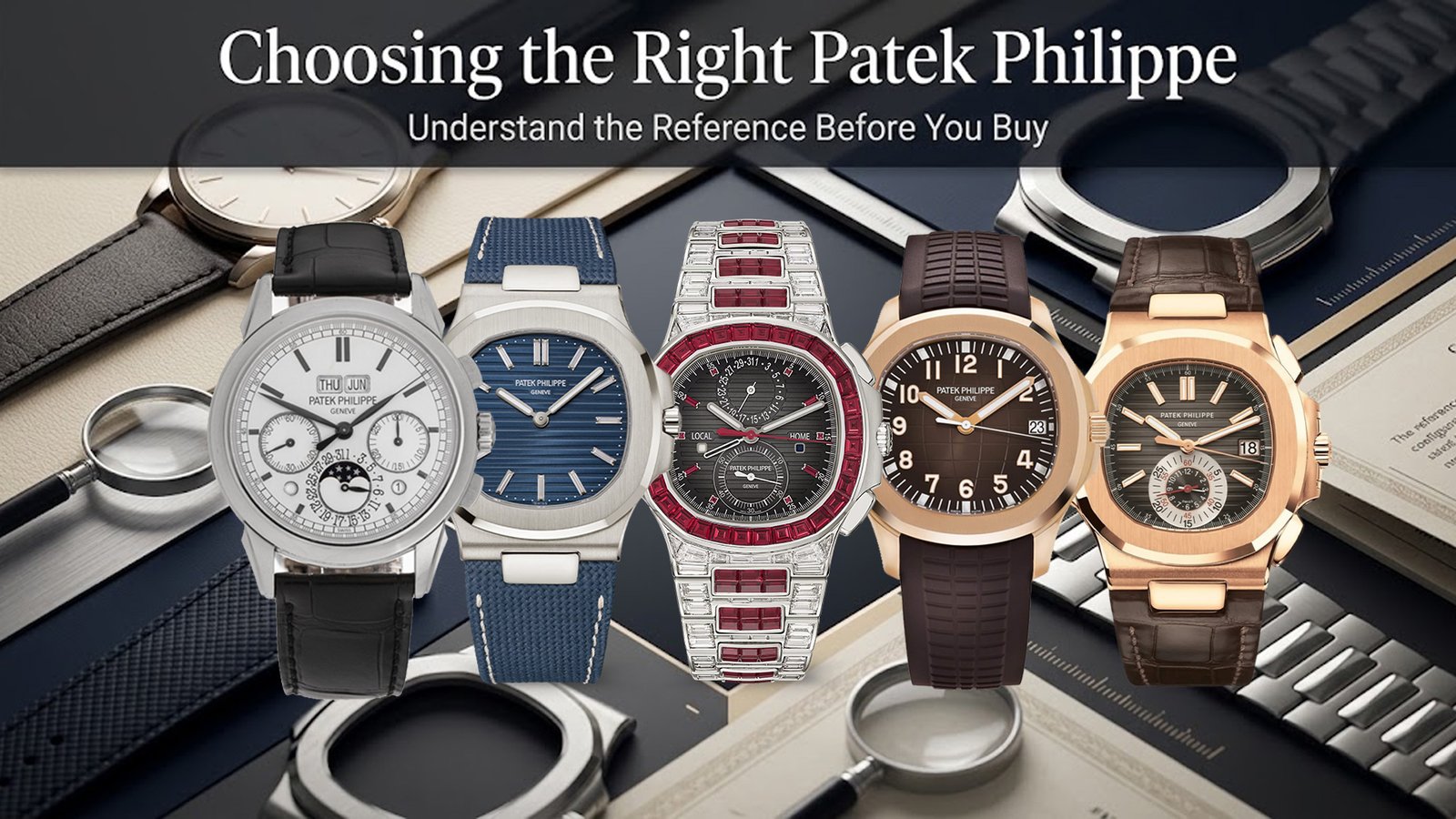
Buying a Patek Philippe is less about choosing the most recognizable model and more about understanding exactly what sits behind a particular reference. Two watches carrying the same family name can differ significantly in case material, movement, complication, production status, condition, originality and secondary-market demand. For buyers in Dubai, where current, discontinued and pre-owned examples can all appear within the same market, careful reference-level comparison matters far more than simply deciding that you want a Nautilus, Aquanaut or Calatrava.
Before buying a Patek Philippe in Dubai, identify the exact reference and configuration, then assess condition, originality, movement and service history, documentation, provenance and the credibility of the seller. Compare prices only between genuinely comparable watches, because reference, material, dial, completeness, production status and condition can materially change what two apparently similar Patek Philippe watches are worth.
Start With the Reference, Not Just the Patek Philippe Name
Patek Philippe produces watches across very different categories. A simple time-only Calatrava, a steel sports watch, a Travel Time model and a perpetual-calendar chronograph may all carry the same manufacturer name, but they present very different ownership, servicing and resale considerations.
This is why a serious Patek Philippe buyer in Dubai should move from family to reference as quickly as possible. Knowing that a watch is an Aquanaut is not enough. You should know the reference number, case material, dial configuration, movement, strap or bracelet arrangement, complication and whether the configuration matches the period in which the watch was produced.
For current availability, buyers can browse the Patek Philippe watches currently listed by Buy & Sell Watches before comparing individual references in more detail.
Collector insight: The family name tells you where a watch sits in the Patek Philippe catalogue. The reference tells you what you are actually buying. In the pre-owned market, that distinction can affect desirability, servicing complexity, rarity, price and eventual resale options.
Which Patek Philippe Collection Fits the Way You Will Actually Wear the Watch?
A useful buyer guide should do more than identify the models that receive the most attention online. The right Patek Philippe depends partly on how often you intend to wear it, where you intend to wear it and how much complexity you genuinely want to own.
| Collection | General Character | What Buyers Should Consider |
| Calatrava | Traditional round dress-watch design with an emphasis on restraint and classical proportions. | Case size, precious-metal condition, dial originality, movement type and whether you prefer understated daily wear or formal use. |
| Nautilus | Sport-oriented Patek Philippe family known for its distinctive case architecture and integrated-bracelet aesthetic. | Exact reference, metal, bracelet condition, number of links, polishing history, dial configuration and whether the reference is current or discontinued. |
| Aquanaut | Contemporary sports collection offered across different sizes and complications, commonly associated with its embossed dial and composite strap. | Strap condition and size, clasp condition, case finishing, reference-specific complications and replacement cost of missing components. |
| Cubitus | A newer Patek Philippe collection with a square-shaped case, rounded edges and horizontally embossed dial design. | Case dimensions, wrist fit, bracelet or strap configuration and how the relatively recent collection fits your ownership preferences. |
| Complications | Models offering functions beyond basic time display, including calendars, chronographs, World Time and Travel Time watches. | Movement condition, correct operation of every function, service history and the additional cost and time involved in maintaining a more complex movement. |
| Grand Complications | High-complexity watchmaking including sophisticated calendar, chronograph and other advanced mechanisms. | Specialist inspection, provenance, service documentation, originality, correct operation and the practical realities of servicing a highly complicated watch. |
The Calatrava has been part of Patek Philippe’s classical identity since the introduction of Ref. 96 in 1932. At the other end of the stylistic spectrum, the relatively new Patek Philippe Cubitus collection debuted in 2024, adding a distinctly shaped sports-oriented family to the modern catalogue.
Neither approach is inherently more desirable. A buyer who wants quiet, traditional watchmaking may find more satisfaction in a Calatrava than in a heavily traded sports reference. Conversely, someone wanting a more casual watch on a bracelet or composite strap may naturally be drawn towards the Nautilus, Aquanaut or Cubitus.
Why Exact Configuration Matters So Much
Once you have identified the reference, confirm its actual configuration. Patek Philippe references can appear in different metals, dial executions, bracelet or strap arrangements and, in some cases, gem-set configurations. Related references can also have materially different movements or complications.
Check the reference against the watch itself rather than trusting the listing title alone. A proper review should consider the case, dial, hands, movement, bracelet or strap, clasp and documentation as a complete package.
This becomes particularly important when comparing pre-owned watches. An attractively priced watch may still be the less appealing purchase if it has a heavily polished case, an incomplete bracelet, an aftermarket modification, unclear replacement components or an expensive service requirement approaching.
Condition Is More Than Scratches on the Case
Cosmetic appearance is only one part of condition. Buyers should separately think about cosmetic condition, structural condition, movement condition, originality and service condition.
A watch that photographs beautifully may have been polished several times. A watch showing light wear may retain sharper case geometry and more original finishing. For certain collectors, particularly those buying discontinued or older references, the latter can be more attractive.
Examine the following areas carefully:
- Case: Look at edges, proportions, finishing and evidence of aggressive refinishing or material removal.
- Dial and hands: Confirm that they are correct for the reference and period, with any replacement or service components disclosed.
- Bracelet: Check wear, clasp operation, missing links, previous refinishing and whether the bracelet is correct for the watch.
- Strap: Assess wear and confirm whether it is original, replacement or aftermarket.
- Movement: Confirm proper operation and have the movement professionally inspected where appropriate.
- Complications: Calendar, chronograph, Travel Time, World Time and other functions should operate correctly.
- Aftermarket work: Diamond setting, altered dials, modified bezels or other non-original components should be identified clearly before purchase.
Because terms such as “mint”, “excellent” or “very good” can vary between sellers, they should not replace a physical assessment. The watch condition grading guide explains the factors that matter beyond a seller’s headline condition label.
Buyer insight: A watch with fewer visible marks is not automatically the better example. For collectible references, preserving original case geometry, finishing and components may matter more than creating a cosmetically flawless appearance through repeated refinishing.
How Important Are Box and Papers for a Patek Philippe?
Original box and documentation can be commercially meaningful, but they should be understood correctly. They can support completeness, ownership history, collector confidence and resale desirability. They do not remove the need to authenticate the physical watch.
Patek Philippe’s Certificate of Origin is particularly important documentation. The manufacturer states that this original document identifies the individual timepiece through information including its reference, case and movement numbers and that a lost Certificate of Origin cannot simply be re-issued.
For older watches, Patek Philippe also offers an Extract from the Archives for eligible pieces first sold at least ten years earlier. The extract transcribes information held in the manufacturer’s archives about the watch’s manufacturing history and original sale.
An Extract from the Archives and an original Certificate of Origin are not the same document, and neither should be treated as a substitute for examining the watch itself. A watch without original papers is not automatically inauthentic, just as the presence of paperwork does not automatically prove that every component currently fitted to a watch is correct.
Service History Can Change the Economics of the Purchase
Service history deserves more attention on a Patek Philippe than many buyers give it. Complicated mechanical watches can require specialist work, and a low purchase price becomes less attractive if substantial maintenance is immediately required.
Ask when the watch was last serviced, who performed the work and whether there are invoices or supporting records. For older or collectible watches, also ask what components were replaced during previous servicing.
Patek Philippe’s current general watch-care guidance recommends servicing mechanical and quartz watches every eight to ten years through an official Service Centre or Authorised Retailer. Actual needs still depend on the specific watch, how it has been used and its mechanical condition.
If service provenance is important to the purchase, review the site’s guide on verifying a luxury watch’s service history before committing to a high-value transaction.
Originality Becomes More Important as a Watch Becomes More Collectible
A modern watch bought primarily for regular wear and a decades-old collector reference are not always judged by exactly the same priorities. On older watches, originality can have significant commercial importance.
A replacement component may be entirely appropriate from a mechanical or usability perspective while still affecting how a collector evaluates the watch. That is why buyers should distinguish between “genuine Patek Philippe component”, “original component fitted when the watch was produced” and “aftermarket component”. They are not interchangeable descriptions.
For older pieces, pay particular attention to dial condition, hands, crown, case geometry, movement correctness, bracelet or buckle, refinishing and documented service work. Where ownership history is material, a broader luxury watch provenance review can help buyers understand what documentation genuinely contributes to confidence.
Authentication Should Be a Process, Not a Single Test
There is no sensible one-step test for authenticating a high-value Patek Philippe. Weight, movement sound, dial printing or the smoothness of the seconds hand cannot independently establish authenticity.
Evaluation should combine the reference and identifying information with the case, movement, dial, hands, crown, bracelet or strap, clasp, engravings, finishing, documentation, service history and overall component correctness.
The sophistication of modern counterfeits also makes photographs alone an inadequate basis for absolute certainty in a high-value transaction. When the value justifies it, qualified physical inspection is the safer approach. Buyers wanting a more detailed framework can consult the site’s guide to luxury watch authentication in Dubai.
How Should You Compare Patek Philippe Prices in Dubai?
Do not compare the asking price of one Patek Philippe with another simply because both watches belong to the same collection. Even watches sharing a family name can occupy entirely different price categories.
A useful comparison should control for as many variables as possible:
- exact reference;
- case material;
- dial and factory configuration;
- production status;
- approximate age;
- condition and polishing history;
- originality;
- box and documentation;
- service history;
- bracelet links, straps and accessories;
- aftermarket modifications; and
- seller terms, warranty and transaction conditions.
It is also important to distinguish asking prices from completed transactions or auction results. A listing demonstrates what a seller would like to receive; it does not necessarily show the price at which a comparable watch recently changed hands.
Because prices can move and references differ substantially, this buyer guide deliberately avoids presenting a single universal “Patek Philippe price”. Buyers researching current pricing should instead use the dedicated Patek Philippe watches price guide for Dubai alongside reference-specific market comparisons.
Resale insight: Rarity and liquidity are not the same thing. A very rare Patek Philippe may have a smaller pool of qualified buyers than a more recognisable reference. If future resale flexibility matters, consider market depth and reference recognition alongside scarcity.
What Buyers Should Check Before Paying for a Patek Philippe
Before funds are transferred, bring the entire purchase together into one final review. The objective is not merely to confirm that the watch is genuine; it is to understand exactly what you are receiving and whether the price reflects that specific example.
- Confirm the complete reference and configuration.
- Check case, dial, hands, movement, bracelet or strap and clasp.
- Ask directly about polishing and refinishing.
- Identify any service or replacement components.
- Identify any aftermarket modifications.
- Review the Certificate of Origin, warranty documents, archives extract or other papers where supplied.
- Review service records and outstanding maintenance requirements.
- Confirm all included accessories, spare links and straps.
- Understand the seller’s authentication process.
- Review warranty, return and inspection conditions before payment.
- Compare the price with genuinely equivalent references and configurations.
- Use an appropriate secure transaction method for the value involved.
Buying a Patek Philippe Online From Dubai
Remote purchasing can make a wider range of watches accessible, but it increases the importance of documentation and seller transparency. Do not rely solely on professionally lit photographs or a short condition description.
Request clear images of the case from multiple angles, dial, clasp, bracelet or strap, caseback and relevant documentation. Ask for the exact reference, condition disclosure, service history, included accessories and a written explanation of any replacement or aftermarket components.
The seller should also be able to explain what happens if the watch received differs materially from its description. Buyers considering a remote transaction can use the more detailed guide to buying Patek Philippe watches online in Dubai for additional transaction-specific checks.
Should You Buy the Most Popular Patek Philippe Reference?
Not necessarily. Popularity can provide stronger recognition and, for certain references, a deeper secondary market. But it can also mean paying a larger premium for demand that may change over time.
The better question is what role the watch will play in your collection. If you want a discreet formal watch, paying a premium for the most recognisable sports model may make little sense. If you want frequent casual wear, a complicated precious-metal dress watch may offer impressive watchmaking without being the most practical choice.
Consider wrist size, weight, thickness, bracelet or strap preference, complication, maintenance tolerance and how often the watch will actually be worn. The watch that makes the strongest purchase on paper is not necessarily the watch you will enjoy owning most.
Frequently Asked Questions
What is the best Patek Philippe to buy in Dubai?
There is no single best reference. A Nautilus, Aquanaut, Cubitus, Calatrava or complicated Patek Philippe suits a different type of buyer. Decide first on your preferred design, size, movement complexity, usage and budget, then compare exact references rather than choosing solely by popularity.
Is a Patek Philippe a guaranteed investment?
No. Certain references have demonstrated strong collector demand and resale performance historically, but future prices are not guaranteed. Secondary-market value can change with reference, condition, originality, production status, availability, completeness and broader collector demand.
Do box and papers prove that a Patek Philippe is authentic?
No. Original documentation can support provenance and completeness, but the watch itself still requires proper evaluation. Papers can become separated from watches, while watches without original documents can still be authentic.
Can a lost Patek Philippe Certificate of Origin be replaced?
Patek Philippe states that the original Certificate of Origin cannot be re-issued. For qualifying older watches, an Extract from the Archives may provide historical manufacturing and sale information, but it is a different document and should not be confused with the original Certificate of Origin.
How often should a Patek Philippe be serviced?
Patek Philippe’s current general care guidance recommends service every eight to ten years through an official Service Centre or Authorised Retailer. A particular watch may need attention earlier depending on its condition, use, age or mechanical performance, so service history should still be assessed individually.
Does polishing reduce the value of a Patek Philippe?
It can affect collector desirability, particularly if repeated or aggressive polishing changes the original case geometry or finishing. Light professional refinishing and heavy material removal should not be treated as equivalent, so buyers should examine the actual case rather than relying only on the word “polished”.
Is a Patek Philippe without papers worth buying?
Potentially, provided the watch is properly authenticated and its condition, originality, provenance and price make sense. Missing documentation may affect buyer confidence, completeness and eventual resale desirability, so it should normally be reflected in the overall evaluation.
What information should I request before buying a pre-owned Patek Philippe?
Ask for the exact reference, approximate year, configuration, detailed condition, polishing history, service history, replacement or aftermarket components, documentation, box, accessories, bracelet links or straps and the seller’s inspection, warranty and return conditions. For a high-value purchase, arrange qualified physical inspection where appropriate.
Discuss Your Patek Philippe Requirements
If you are comparing a particular Patek Philippe in Dubai, start with the exact reference rather than the collection name alone. Buy & Sell Watches can help you review available Patek Philippe watches in Dubai according to reference, configuration, condition and set details so that you can compare relevant options more accurately.
For a pre-owned purchase, provide as much detail as possible about the reference you are considering, including material, dial, approximate year, condition, box and papers and service history. That information produces a more useful comparison than asking for a general Patek Philippe recommendation or a single brand-wide price.