 +971 58 515 9269


Richard Mille RM 36-01: What Buyers Should Understand Before Purchasing Pre-Owned

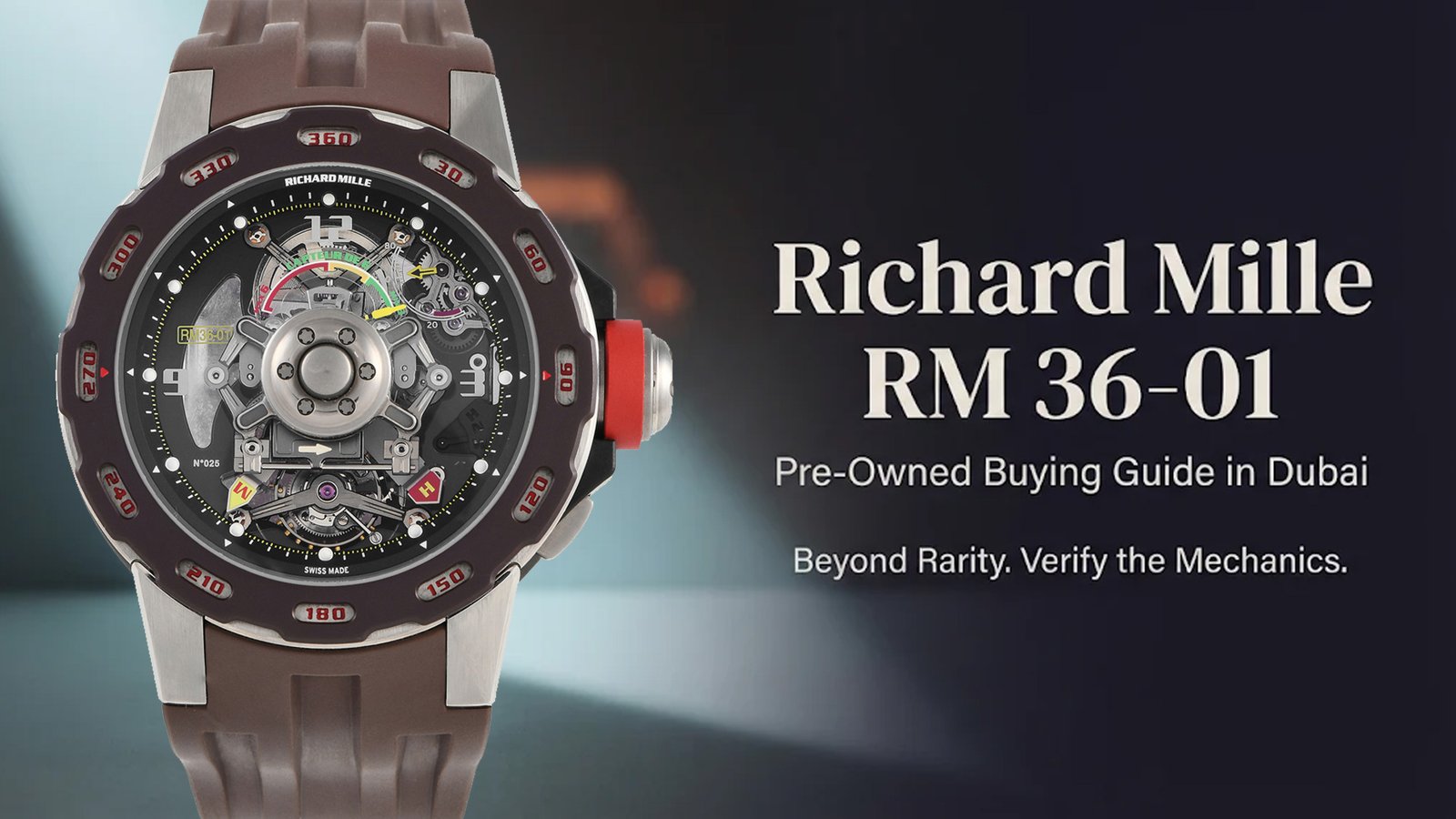
A Tourbillon That Measures G-Forces? Here’s Why the RM 36-01 Demands a Different Buying Approach
The Richard Mille RM 36-01 is an unusual mechanical watch, even by the standards of highly complicated contemporary horology. Developed around a tourbillon movement and a mechanical G-force sensor, it brings together traditional watchmaking techniques and a mechanism inspired by motorsport engineering.
Officially named the RM 36-01 Tourbillon G-Sensor Sébastien Loeb, the reference was introduced in 2014 as a limited edition of 30 watches. It was developed in collaboration with Sébastien Loeb, the nine-time World Rally Champion.
Its most distinctive feature is the ability to indicate G-forces through a mechanical sensor incorporated into the watch’s architecture. The rotating assembly allows the sensor to be oriented for different directions of force, while the tourbillon movement provides mechanical timekeeping.
For someone considering a pre-owned Richard Mille RM 36-01 in Dubai, this is not a watch that should be evaluated solely through photographs, a reference number or an attractive presentation. The functioning of its complications, originality of components, service history and completeness of the watch deserve careful attention.
Richard Mille RM 36-01: Verified Technical Specifications
| Specification | Richard Mille RM 36-01 |
| Official model name | RM 36-01 Tourbillon G-Sensor Sébastien Loeb |
| Original introduction | 2014 |
| Official limited edition | 30 pieces |
| Movement | Calibre RM36-01 |
| Winding | Manual |
| Functions | Hours, minutes, tourbillon, G-sensor, power-reserve indication, function selector |
| Published case diameter | 47.70mm |
| Caseband material | Carbon-nanotube composite |
| Fixed structural bezel and caseback | Titanium |
| G-sensor orientation | Rotating ceramic assembly |
| G-force indication range | Up to 6G |
| Power reserve | Approximately 70 hours |
| Power-reserve display | Near 2 o’clock |
| Function selector | Near 4 o’clock |
| G-sensor reset | Central pusher on the sapphire assembly |
These details follow Richard Mille’s historical technical description of the reference. An individual pre-owned watch must still be assessed for component originality, physical condition and correct operation.
- Understanding the RM 36-01’s Motorsport Connection
The RM 36-01 was developed in collaboration with Sébastien Loeb, whose competitive career included nine consecutive World Rally Championship titles.
The relationship between the watch and motorsport goes beyond its name or appearance.
Richard Mille incorporated a mechanical G-force indicator, a complication related to the forces experienced during acceleration, braking and cornering.
This followed the development of mechanical G-force sensor watches already present in the manufacturer’s collection.
The RM 36-01 expanded the concept by introducing a rotating sensor assembly capable of being oriented to measure force in different directions.
For collectors, this unusual combination of mechanical watchmaking and motorsport instrumentation is central to the reference’s identity.
- How Does the Richard Mille G-Sensor Work?
The Richard Mille G-Sensor Tourbillon incorporates a mechanical system capable of indicating G-forces of up to six times the acceleration due to gravity.
Unlike an electronic accelerometer that displays data digitally, the RM 36-01 uses a mechanical indicator integrated into the watch.
The rotating ceramic assembly allows the wearer to orient the sensor to respond to different directions of force.
Longitudinal and Lateral Forces
In motorsport, longitudinal forces are associated with acceleration and braking, while lateral forces are experienced during cornering.
The RM 36-01’s rotating G-sensor was designed so that it could be oriented to indicate forces associated with these different driving situations.
The display includes a scale with green and red zones.
These zones provide a visual interpretation of the force measured by the mechanism. They should not be understood as a guarantee of vehicle safety or a substitute for specialist driving instrumentation.
What Does the Central Pusher Do?
Richard Mille’s official technical description identifies a central pusher that resets the sensor indication to zero.
This feature is integrated into the sapphire assembly.
The mechanism is unusual and should not be operated casually by someone unfamiliar with the watch.
When evaluating a pre-owned example, request an appropriate demonstration from someone qualified to handle the complication.
Do not force the rotating assembly or attempt to repair a malfunctioning sensor without specialist expertise.
- Why the Rotating Sensor Assembly Is Technically Significant
One of the RM 36-01’s most interesting engineering details is the relationship between the mobile sensor assembly and the rest of the movement.
Richard Mille describes a construction in which some components are positioned on the movement’s baseplate while others are attached to the rotating bezel and sapphire assembly.
This creates a mechanical system that can move for directional adjustment while remaining integrated into the watch’s broader architecture.
The result is considerably more complicated than attaching an ordinary indicator to a conventional dial.
What Should Buyers Inspect?
Because the sensor mechanism is specialized, a pre-owned assessment should consider:
- Whether the rotating assembly moves as intended.
- Whether the G-force indication is functioning correctly.
- Whether the central reset control operates normally.
- Whether the sapphire assembly shows visible damage.
- Whether any previous sensor-related repairs are documented.
- Whether the watch has received a suitable technical examination.
A photograph of the sensor at zero does not establish that it functions across its intended range.
Likewise, a short demonstration does not replace specialist mechanical inspection when there is uncertainty about its condition.
- Calibre RM36-01: Manual Winding and Tourbillon Construction
The RM 36-01 uses a manually wound tourbillon movement.
This means the mainspring is wound through the appropriate crown and setting mechanism rather than relying on an automatic rotor.
Richard Mille specifies approximately 70 hours of power reserve.
The watch also includes a power-reserve indicator near two o’clock and a function selector near four o’clock.
Why Manual Winding Matters
A manual-winding watch requires the owner to manage its available power rather than relying on wrist movement to maintain winding.
This is not necessarily inconvenient, but it creates a different ownership routine from an automatic Richard Mille.
Before purchasing pre-owned, ask for the correct operating instructions and confirm that winding and function selection behave as intended.
What Does the Tourbillon Add?
A tourbillon places the regulating assembly within a rotating cage.
Historically, the concept was developed to address positional timing effects in mechanical timepieces.
In a modern wristwatch, the presence of a tourbillon should not be interpreted as a guarantee of superior accuracy.
The condition, adjustment and service history of the specific movement remain important.
For a specialist reference such as the RM 36-01, an appropriate technical assessment should examine the complete movement rather than simply confirming that the tourbillon cage rotates.
- Carbon-Nanotube Composite and Titanium Case Construction
The case materials are another defining characteristic of the RM 36-01.
Richard Mille’s official description specifies a case diameter of 47.70mm, with a caseband formed from carbon-nanotube composite.
The fixed structural bezel and caseback are made from titanium.
Separate from that fixed structural component, the rotating ceramic assembly serves the G-sensor mechanism.
These distinctions matter because the watch combines several materials and mechanical elements that should not be casually described as one interchangeable component.
Inspecting the Case
When evaluating a pre-owned example, examine:
- The carbon-composite caseband for visible damage.
- The titanium case components for dents or substantial marks.
- The condition of the rotating ceramic assembly.
- The sapphire crystal and its surrounding components.
- The alignment and condition of external controls.
- Any evidence of previous repairs or replacement parts.
Unusual marks or damage should be assessed by a suitably qualified watch professional.
Do not assume that repairs suitable for ordinary steel watches can be applied to specialist composite and ceramic case components.
- Does the RM 36-01 Wear Like a Conventional 47mm Watch?
Not necessarily.
The RM 36-01 has a 47.70mm manufacturer-specified case diameter, but its overall geometry, materials and strap connection also influence wrist presence.
The watch’s architecture is visually substantial, with multiple visible mechanisms and a prominent sensor assembly.
Despite the use of lightweight technical materials in parts of the case, comfort should be evaluated through an actual fitting rather than assumptions based on material names.
Strap Fit and Condition
The strap affects how securely the case sits on the wrist.
Inspect the strap for cracking, stretching, tears or damage near the attachment points.
Confirm that any replacement strap and clasp components are suitable for the exact watch.
A pre-owned example may have been fitted with a replacement strap, so buyers should establish whether that component is original, a genuine replacement or aftermarket.
- Why Service History Is Particularly Important
The RM 36-01 Sébastien Loeb is not a conventional time-only mechanical watch.
Its movement combines a tourbillon with a specialized mechanical sensor and related controls.
That complexity makes service history a significant part of the purchasing assessment.
Ask whether the watch has undergone previous servicing, repairs or component replacement.
Documentation should identify the watch and describe the work completed wherever possible.
Questions Worth Asking
- When was the watch most recently serviced?
- Who performed the work?
- Were repairs made to the G-sensor mechanism?
- Was the tourbillon movement inspected?
- Were any case or sapphire components replaced?
- Are service invoices or technical reports available?
- Were all functions checked after servicing?
The cost and availability of specialist service should be investigated before purchasing rather than treated as a minor future consideration.
A watch that currently tells time may still have unresolved issues involving its sensor or function selector.
For additional context about evaluating prior maintenance, read the luxury watch service-history verification guide.
- Limited Edition of 30: What Does That Mean for Buyers?
Richard Mille officially identifies the RM 36-01 as a limited edition of 30 watches.
This production figure is a documented manufacturer specification rather than an estimate based on market advertising.
However, a limited production number does not automatically establish how many watches are currently available for sale or how much a particular example should cost.
It also does not guarantee future appreciation.
Why Provenance Matters
For a limited-production specialist watch, provenance can help buyers understand the relationship between the individual watch and its original presentation.
Request the available original purchase documentation, manufacturer records where obtainable, service history and accessories.
Confirm that the identifying details correspond with the watch being offered.
Be cautious about unsupported claims concerning ownership by famous individuals or historical significance beyond the manufacturer’s documented collaboration.
Any special provenance claim should be supported by credible evidence.
For a broader explanation, consult the luxury watch provenance guide.
- How to Evaluate a Richard Mille RM 36-01 Listing in Dubai
Buy & Sell Watches has a dedicated Richard Mille RM 36-01 Tourbillon G-Sensor Sébastien Loeb listing.
The page describes a pre-owned example and provides information about its stated year, presentation and watch configuration.
Before proceeding, confirm the individual watch’s specifications, supporting documentation and present availability.
A particular dealer listing should not be treated as evidence of the wider secondary market’s selling prices.
Why the Listed Year Needs Context
The RM 36-01 model was introduced in 2014, but a listing may display a later year associated with the particular watch.
That later date should not be interpreted as the introduction year of the reference.
Ask whether the stated year refers to the original sale, a documented transaction, another ownership event or information recorded by the seller.
This distinction can be important when comparing provenance and accompanying documents.
- Comparing RM 36-01 Prices With Other Richard Mille References
A Richard Mille RM 36-01 price in Dubai should not be evaluated using broad Richard Mille averages.
The RM 36-01 has a specialized mechanical G-sensor, manual-winding tourbillon and documented limited production.
Those characteristics distinguish it from automatic Richard Mille references with completely different movement architectures.
Useful price comparisons should account for:
- Exact reference and documented edition identity.
- Original configuration and component originality.
- Condition of the case and sensor assembly.
- Correct operation of the G-sensor.
- Tourbillon movement condition.
- Service history and potential outstanding maintenance.
- Original documentation and accessories.
- Whether comparable prices represent asking prices or completed sales.
For further context on why apparently similar Richard Mille watches can have different asking prices, read the Richard Mille pricing comparison guide.
You can also explore the wider Richard Mille watch collection in Dubai.
- A Final RM 36-01 Buying Checklist
Before committing to a high-value purchase, request a clear assessment of the following:
- Full model identity and available edition documentation.
- Original case and movement configuration.
- Condition of the rotating ceramic sensor assembly.
- Operation of the G-force display and reset mechanism.
- Function selector and power-reserve indication.
- Manual winding and tourbillon operation.
- Condition of the sapphire crystal and titanium components.
- Original strap and clasp information.
- Documented service history.
- Current asking price, currency and transaction terms.
Any significant uncertainty should be addressed through an appropriate specialist inspection.
Frequently Asked Questions
What is the Richard Mille RM 36-01?
The RM 36-01 is a manual-winding tourbillon watch developed in collaboration with rally driver Sébastien Loeb. It incorporates a mechanical G-force sensor and was introduced in 2014.
How many Richard Mille RM 36-01 watches were made?
Richard Mille officially identifies the reference as a limited edition of 30 pieces.
How does the RM 36-01 G-sensor work?
The mechanical sensor indicates G-forces of up to 6G. Its rotating assembly allows orientation for different directions of force, and a central pusher resets the indication.
Is the Richard Mille RM 36-01 automatic?
No. It uses calibre RM36-01, a manually wound tourbillon movement with approximately 70 hours of power reserve.
What materials are used in the RM 36-01 case?
The manufacturer’s historical specifications identify carbon-nanotube composite for the caseband, titanium for the fixed structural bezel and caseback, and a rotating ceramic assembly associated with the G-sensor.
Where can I enquire about a Richard Mille RM 36-01 in Dubai?
Review the RM 36-01 product listing or request an appointment with Buy & Sell Watches to discuss the watch’s current details and documentation.
Final Verdict: A Specialist Mechanical Watch Requires Specialist Due Diligence
The Richard Mille RM 36-01 stands apart through its combination of manual-winding tourbillon, rotating mechanical G-force sensor and advanced case construction.
Its documented edition of 30 pieces adds historical interest, but production numbers alone do not establish the condition or value of an individual example.
For a pre-owned purchase, the decisive considerations are correct operation of the sensor, mechanical condition, provenance, originality and access to appropriate specialist maintenance.
Explore the RM 36-01 in Dubai: View the Richard Mille RM 36-01 listing or contact Buy & Sell Watches to enquire about the watch and its available documentation.