 +971 58 515 9269


Rolex Day-Date 36 vs Day-Date 40: Which Reference and Configuration Should You Buy?

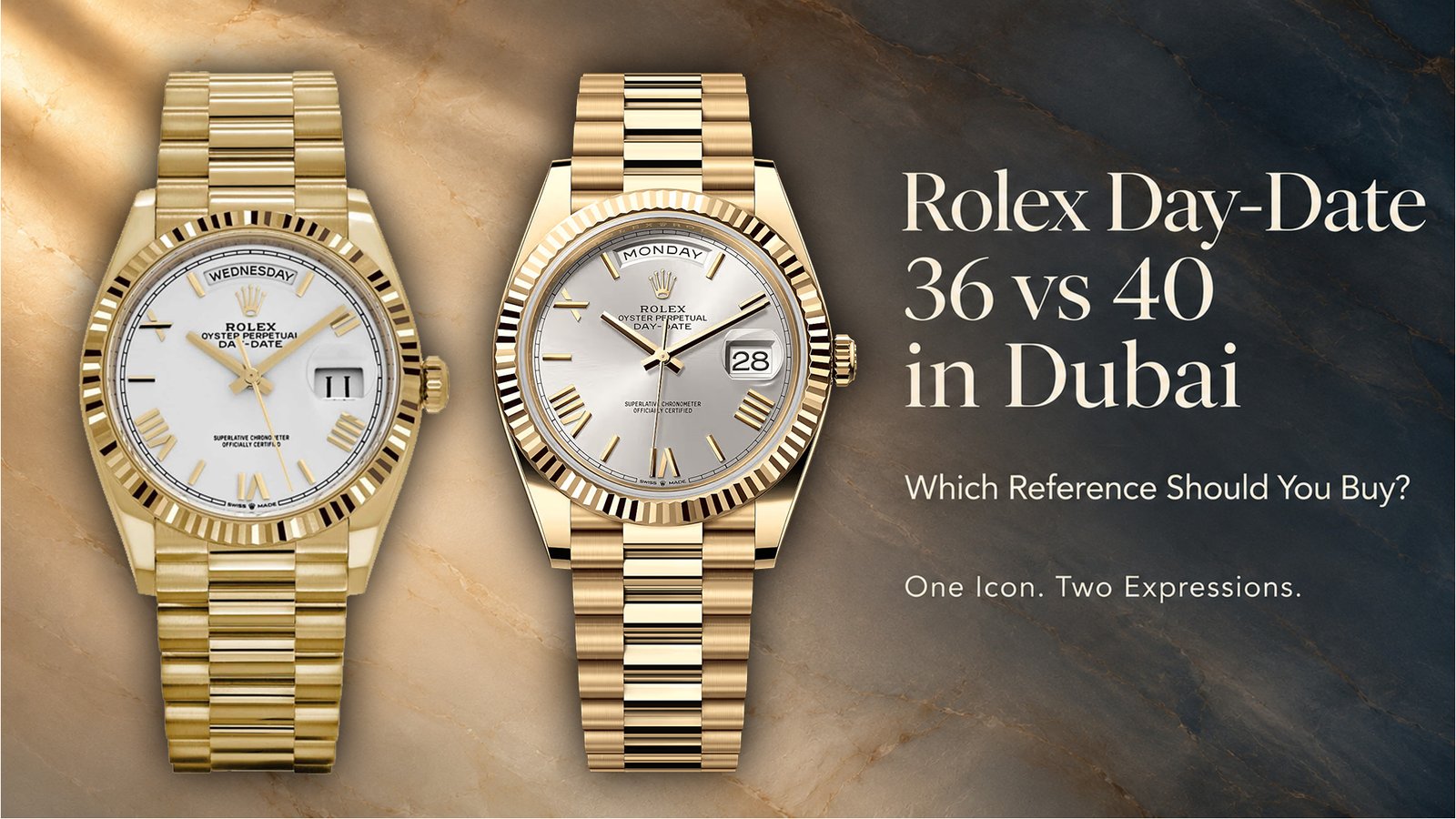
Same Iconic President Design, Two Very Different Wearing Experiences—Which One Deserves Your Wrist?
The Rolex Day-Date 36 vs 40 comparison is one of the most important decisions facing buyers who want a precious-metal Rolex with the collection’s signature day-and-date display. Both models carry an instantly recognizable design, but their differences become more meaningful when you consider wrist proportions, bracelet fit, dial selection and pre-owned condition.
The modern Day-Date 36 reference 128238 and Day-Date 40 reference 228238 provide a particularly useful comparison. Both use 18-karat yellow gold, feature a fluted bezel and are powered by Rolex calibre 3255. Both display the day in a window at 12 o’clock and the date beneath a Cyclops lens at 3 o’clock.
However, choosing between 36 mm and 40 mm is not simply about buying a smaller or larger version of the same watch. Their proportions affect how the case and President bracelet sit together, while the available dials can make individual examples appear substantially different.
For anyone planning to buy a pre-owned Rolex Day-Date in Dubai, the best decision begins with fit and reference accuracy, followed by an honest assessment of originality, condition and documentation.
Rolex Day-Date 128238 vs 228238: Technical Specifications
Both references belong to the modern Day-Date generation and share the same principal movement technology. This comparison focuses on the yellow-gold, fluted-bezel configurations rather than every precious-metal variation in the collection.
| Specification | Day-Date 36 — 128238 | Day-Date 40 — 228238 |
| Collection | Day-Date 36 | Day-Date 40 |
| Case diameter | 36 mm | 40 mm |
| Case material | 18 kt yellow gold | 18 kt yellow gold |
| Bezel | Fluted, 18 kt yellow gold | Fluted, 18 kt yellow gold |
| Movement | Rolex calibre 3255 | Rolex calibre 3255 |
| Winding | Self-winding | Self-winding |
| Power reserve | Approximately 70 hours | Approximately 70 hours |
| Day display | 12 o’clock | 12 o’clock |
| Date display | 3 o’clock, with Cyclops | 3 o’clock, with Cyclops |
| Crown | Screw-down Twinlock | Screw-down Twinlock |
| Water resistance | 100 metres | 100 metres |
| Bracelet | President, three-piece semicircular links | President, three-piece semicircular links |
| Clasp | Concealed folding Crownclasp | Concealed folding Crownclasp |
Although the fundamental specifications are comparable, dial and gem-setting options differ among complete model configurations. Buyers should always identify the specific watch rather than assuming that every Day-Date of a given diameter is identical.
- Rolex Day-Date 36: The Appeal of Traditional Proportions
The Rolex Day-Date 36 retains the case diameter associated with the original Day-Date concept introduced in 1956. That historical connection makes the 36 mm format particularly attractive to buyers who appreciate classic watch proportions.
Despite its relatively compact diameter, a yellow-gold Day-Date is not visually insignificant. Its fluted bezel, broad bracelet links and precious-metal finish give the watch considerable presence.
On many wrists, the 36 mm case provides a balanced relationship between the dial and President bracelet. The result can be particularly effective with formal clothing.
Who Should Consider the Day-Date 36?
The 36 mm model may appeal if you:
- Prefer traditional dress-watch proportions.
- Want a watch that sits comfortably beneath tailored shirt cuffs.
- Appreciate a compact case without sacrificing precious-metal construction.
- Prefer the visual relationship between the smaller dial and President bracelet.
- Enjoy wearing one watch across formal and everyday occasions.
The 36 mm Day-Date should not be described as exclusively suitable for smaller wrists or a particular gender. Personal preferences and wrist shape matter more than such classifications.
- Rolex Day-Date 40: Greater Presence Without Additional Complications
The Rolex Day-Date 40 uses a larger case while retaining the familiar day-and-date display and President bracelet.
Reference 228238 measures 40 mm and offers a more prominent dial and bezel presentation than its 36 mm counterpart.
This can appeal to someone accustomed to contemporary Rolex sports watches or larger luxury timepieces.
However, the larger case does not add a new complication or inherently superior movement.
Why Buyers Choose the 40 mm Model
The Day-Date 40 may be preferable if you value:
- A larger dial with greater visual presence.
- Modern case proportions.
- A more substantial precious-metal wearing experience.
- The appearance of a broader fluted bezel.
- A design that stands out more noticeably on the wrist.
None of these qualities establishes that the 40 mm model is the better purchase for everyone. A watch that looks impressive in photographs may feel too large when worn for an entire day.
- Why Four Millimetres Make a Noticeable Difference
Case diameter is a useful starting point, but it does not describe the complete fit of a Day-Date.
The case profile, bracelet attachment points and shape of the wrist affect how the watch feels.
The Day-Date 40 occupies more wrist space, while the Day-Date 36 generally offers a more compact footprint.
A wider wrist does not automatically require a 40 mm case. Similarly, someone with a smaller wrist may still prefer the larger watch.
A Practical Fitting Checklist
- Try both references with correctly sized bracelets.
- Observe whether the case sits centrally on the wrist.
- Check whether the first bracelet links extend comfortably.
- Assess the position of the concealed clasp beneath the wrist.
- Move your wrist naturally and look for excessive shifting.
- Try the watch beneath the clothing you normally wear.
In Dubai, where the wrist may expand slightly during warmer weather, a bracelet that initially feels comfortable should still allow for natural movement.
- Calibre 3255: Does the Larger Day-Date Have a Better Movement?
Both the 128238 and 228238 use Rolex calibre 3255.
This automatic mechanical movement provides centre hours, minutes and seconds, plus independently displayed day and date indications with rapid-setting capability.
The movement incorporates Rolex’s Chronergy escapement, Parachrom hairspring and Paraflex shock absorbers.
Rolex specifies approximately 70 hours of power reserve and a precision standard of minus two to plus two seconds per day after casing.
These shared specifications mean that the 40 mm case does not deliver an inherent timekeeping advantage over the 36 mm model.
What Matters More When Buying Pre-Owned?
The mechanical condition of the individual watch is more important than case diameter.
Ask whether service records are available, whether the day and date indications operate correctly and whether any previous repairs have been disclosed.
A watch maintaining acceptable time during a brief demonstration may still have unresolved maintenance needs.
For high-value purchases, additional professional inspection may be appropriate.
- The President Bracelet: What Makes It Different?
The President bracelet is central to the Day-Date’s identity.
It features three-piece semicircular links and, in the specified modern configurations, a concealed folding Crownclasp.
Unlike an ordinary sports bracelet, its appearance is closely connected with the Day-Date’s precious-metal case.
Both references discussed here use yellow-gold President bracelets.
How to Inspect a Pre-Owned President Bracelet
Bracelet condition deserves particular attention because of its contribution to comfort, appearance and completeness.
Examine the links for excessive wear, damage or unusual lateral movement.
Check the clasp’s engagement and the alignment of the links when the bracelet is closed.
Ask whether any links were removed and whether those original components remain available.
Do not assume that a shortened bracelet can be extended conveniently without additional components or expense.
Previous polishing should also be evaluated, particularly where the original surface transitions appear uneven.
- Factory Dials, Diamonds and Reference Configuration
The Day-Date collection includes numerous dial materials, colors and decorative configurations.
Some watches feature conventional hour markers, while others have factory-set diamonds or more elaborate dial treatments.
A buyer should not assume that every dial presented as a Rolex Day-Date factory configuration is original to the particular watch.
Factory-Set vs Aftermarket Diamonds
Rolex produces Day-Date references with factory-set diamonds, but independent modifications also exist in the secondary market.
Where a watch contains diamonds or a distinctive dial, confirm whether that configuration corresponds to the original reference and available documentation.
Aftermarket modifications should be disclosed clearly rather than presented as factory-original.
Replacement dials and other genuine service components should also be distinguished from independently manufactured parts.
For further information, read the Rolex service parts and originality guide.
- Gold Case Condition and Previous Polishing
The Day-Date 128238 and 228238 use 18-karat gold cases and bracelets.
Gold surfaces can develop contact marks during normal ownership. Those marks should be assessed in the context of the watch’s age and overall condition.
However, polishing and refinishing require care.
Excessive material removal can soften case edges, alter lug geometry or reduce the definition of a fluted bezel.
What Should Buyers Examine?
- Definition and consistency of the fluted bezel.
- Condition of the case sides and lugs.
- Surface marks on the President bracelet.
- Clasp alignment and security.
- Originality of the dial and hands.
- Evidence of substantial previous refinishing.
- Any documentation describing case or bracelet repairs.
Professional polishing is not automatically a reason to reject a watch, but buyers should understand what work has been performed.
The luxury watch condition grading guide provides a broader framework for assessing preservation.
- How to Compare Day-Date 36 and 40 Prices in Dubai
When comparing a Rolex Day-Date 36 price in Dubai with a Rolex Day-Date 40 price in Dubai, consider the precise configuration rather than focusing only on size.
Case material, dial, factory gem settings, bracelet completeness, condition and documentation may all influence asking prices.
A Day-Date 36 with an elaborate factory-set dial should not automatically be compared with a simpler Day-Date 40.
Similarly, an older Day-Date reference may use a different movement and construction from the modern references discussed here.
Buy & Sell Watches maintains a Rolex watch collection containing Day-Date models, including listings identified as reference 228238.
Exact availability, condition and accompanying documentation should be confirmed directly before comparing individual offers.
- Does the Day-Date 40 Have Better Resale Value?
There is no responsible basis for claiming that the larger Day-Date will always achieve a better resale outcome.
Actual resale interest depends on the reference, configuration, condition, supporting documentation and market circumstances.
The price paid at purchase is also important.
A highly desirable configuration purchased at an excessive asking price can produce a different outcome from the same watch acquired under more favorable terms.
Neither case diameter nor precious-metal content guarantees appreciation.
For broader considerations, read the Rolex Day-Date buying guide for Dubai.
- Which Rolex Day-Date Should You Choose?
Choose the Day-Date 36 if: you prefer traditional proportions, a compact case and understated formal versatility.
Choose the Day-Date 40 if: you prefer a larger dial, greater wrist presence and more contemporary sizing.
Prioritize the individual watch if: both sizes appeal to you but one example has better-preserved case geometry, more complete bracelet links or stronger service documentation.
For a high-value pre-owned purchase, the best-fitting reference should also be the one whose condition and history you can understand.
Frequently Asked Questions
What is the difference between Rolex Day-Date 36 and 40?
The principal difference is case diameter: 36 mm for reference 128238 and 40 mm for reference 228238. Both use calibre 3255 and offer the same core day-and-date functions.
Is Rolex 128238 made from solid gold?
Reference 128238 is an 18-karat yellow-gold Day-Date 36. The case, bezel and President bracelet use yellow gold in the specified configuration.
Does Day-Date 40 have a better movement than Day-Date 36?
No inherent movement advantage results from the larger case. Both modern references use Rolex calibre 3255, with approximately 70 hours of power reserve.
Which Rolex Day-Date has the President bracelet?
Both the 128238 and 228238 use a President bracelet with semicircular three-piece links and a concealed folding Crownclasp.
Is the Rolex Day-Date 36 too small for men?
No. The 36 mm Day-Date has classic proportions suitable for a wide range of personal styles. Wrist fit should be evaluated individually.
Where can I enquire about pre-owned Rolex Day-Date watches in Dubai?
Explore the Rolex collection at Buy & Sell Watches or arrange an appointment to discuss available Day-Date references.
Final Verdict: Choose the Right Proportions, Then Evaluate the Watch
The Rolex Day-Date 36 vs 40 decision is primarily about wearing proportions and configuration preferences.
The 36 mm model offers a classic and relatively restrained interpretation of the President watch. The 40 mm model provides greater visual presence while sharing the same modern movement technology.
For a pre-owned purchase, inspect the gold case, President bracelet, factory configuration and documented service history carefully.
Explore Rolex Day-Date watches in Dubai: Browse the pre-owned Rolex collection or contact Buy & Sell Watches to enquire about a specific reference.